El Niño Expected to Bring Below-Normal Rainfall to India and Increase Global Heat-Related Deaths
A strong El Niño climate pattern is expected to bring below-normal rainfall to most of India from October to December 2026, potentially stressing farms and forests. Globally, this El Niño is projected to cause a significant increase in heat-related deaths and more extremely hot days, with India among the hardest-hit countries.
By The Junior Post
Published
Recommended for ages 10+. Editorial guidance, not a guarantee of individual suitability.
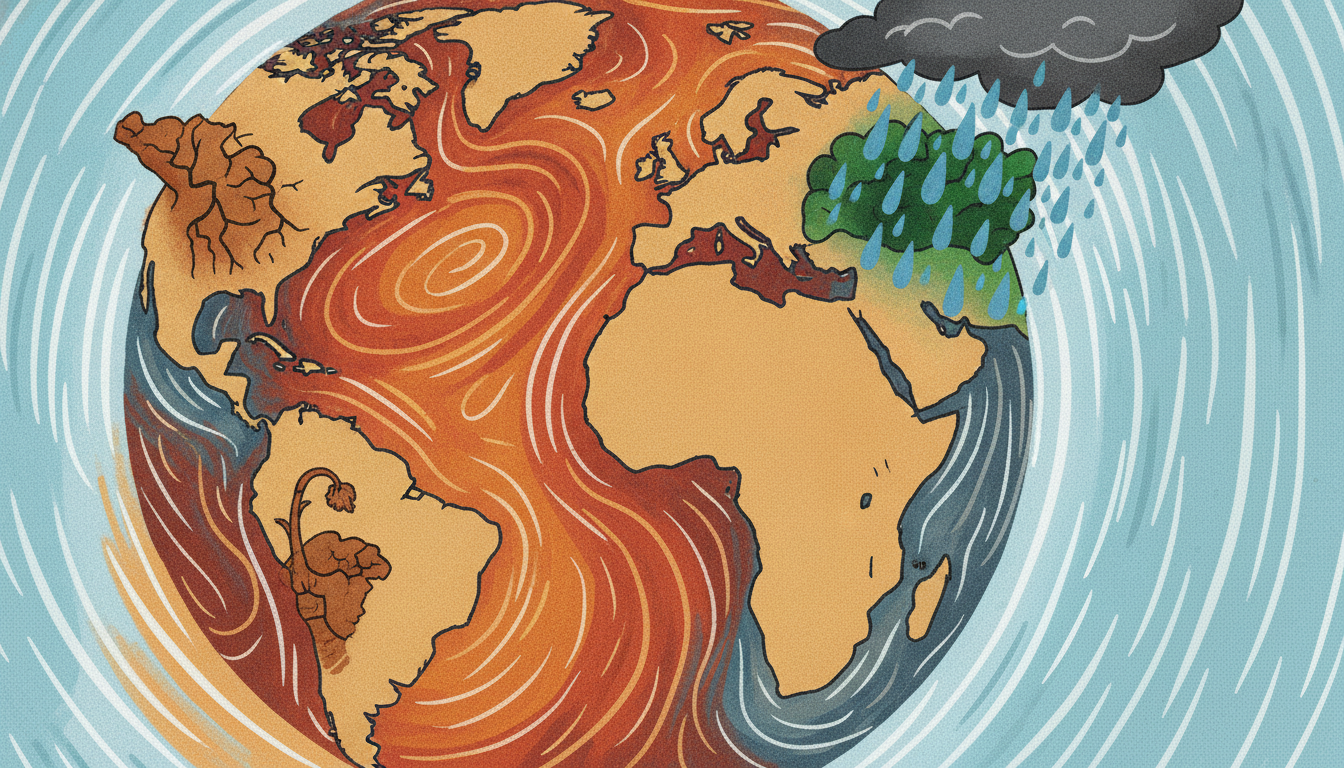
A powerful El Niño climate pattern is expected to strengthen and bring below-normal rainfall to most of India between October and December 2026. This forecast, reported by the India Meteorological Department (IMD), suggests that farms, forests, and oceans could face increased stress, affecting people's lives and how they earn a living.
The current El Niño is projected to be one of the strongest ever recorded, with its effects likely to continue into 2027. Data from the Climate Impact Lab (CIL) indicates that global land temperatures could be 1.2°C higher than normal, leading to 44% more extremely hot days than in a typical year. India is estimated to be among the four countries most affected by this heat, alongside Nigeria, Indonesia, and Sudan.
The El Niño Heat Mortality Tracker, also from the Climate Impact Lab, predicts around 857,000 additional heat-related deaths worldwide between June 2026 and March 2027. The World Meteorological Organization (WMO) confirmed on October 21, 2026, that the effects of this strong El Niño would be felt into 2027.
The Niño 3.4 region in the central-equatorial Pacific, a key area for measuring El Niño's strength, recorded a sea surface temperature exceeding 30°C for the first time in history on October 5, 2026. This El Niño is projected to peak with a temperature anomaly of 3.8°C in this region, which would be the highest since records began. Previous strong El Niño events, like those in 2015-16, 1997-98, and 1982-83, had lower temperature anomalies.
While El Niño usually weakens India's southwest monsoon and increases the risk of drought, Tamil Nadu might experience very heavy rainfall and cyclones during the northeast monsoon (October-December). This is due to factors such as a warmer southern Bay of Bengal, which was about 1°C warmer than usual in September 2026, and a "wind tunnel effect."
United Nations officials have noted that this strengthening El Niño has already broken intensity records in its early stages. Celeste Saulo, the WMO Secretary-General, highlighted that this El Niño, occurring with unusually warm oceans and rising temperatures, gives governments a chance to prepare for risks before they happen.
Knowledge Vault
El Niño Climate Pattern
El Niño is a natural climate pattern that happens when the surface waters in the central and eastern Pacific Ocean become warmer than usual. This change in ocean temperature affects weather patterns all over the world, leading to different conditions like droughts in some areas and heavy rainfall in others. The effects can last for several months and sometimes even into the next year.
Temperature Anomaly
A temperature anomaly is the difference between the observed temperature and the average temperature for a particular place and time. For example, if the average temperature for October in a city is 25°C, but one October it is 28°C, the temperature anomaly is +3°C. Scientists use anomalies to understand how much warmer or colder it is compared to what is normal, which helps them track climate changes.
Monsoon Seasons in India
India experiences different monsoon seasons. The southwest monsoon, which typically occurs from June to September, brings most of the country's rainfall. The northeast monsoon, from October to December, primarily affects southern parts of India, like Tamil Nadu. These monsoons are crucial for agriculture and water supply, and their strength can be influenced by global climate patterns like El Niño.
Check your understanding
- What is one expected impact of the strong El Niño on most of India between October and December 2026?
- Above-normal rainfall
- Below-normal rainfall
- Colder than usual temperatures
- No change in weather patterns
- According to the Climate Impact Lab, what is a global consequence of the current El Niño?
- A decrease in global land temperatures
- Fewer extremely hot days worldwide
- Approximately 857,000 additional heat-related deaths worldwide
- A significant increase in global ocean levels
- Why might Tamil Nadu experience extreme rainfall and cyclones during the northeast monsoon, even though El Niño typically causes drought in India?
- Because the southwest monsoon is unusually strong.
- Due to a colder southern Bay of Bengal and a 'wind tunnel effect'.
- Because of a warmer southern Bay of Bengal and a 'wind tunnel effect'.
- The El Niño has no effect on Tamil Nadu's monsoon.