Electric Vehicle Demand Outpaces Production in India
India's electric vehicle (EV) industry is experiencing a surge in demand that manufacturers are struggling to meet, leading to calls for increased production capacity and stronger supplier networks. Despite a significant rise in EV production, consumer interest continues to grow even faster.
By The Junior Post
Published
Recommended for ages 10+. Editorial guidance, not a guarantee of individual suitability.
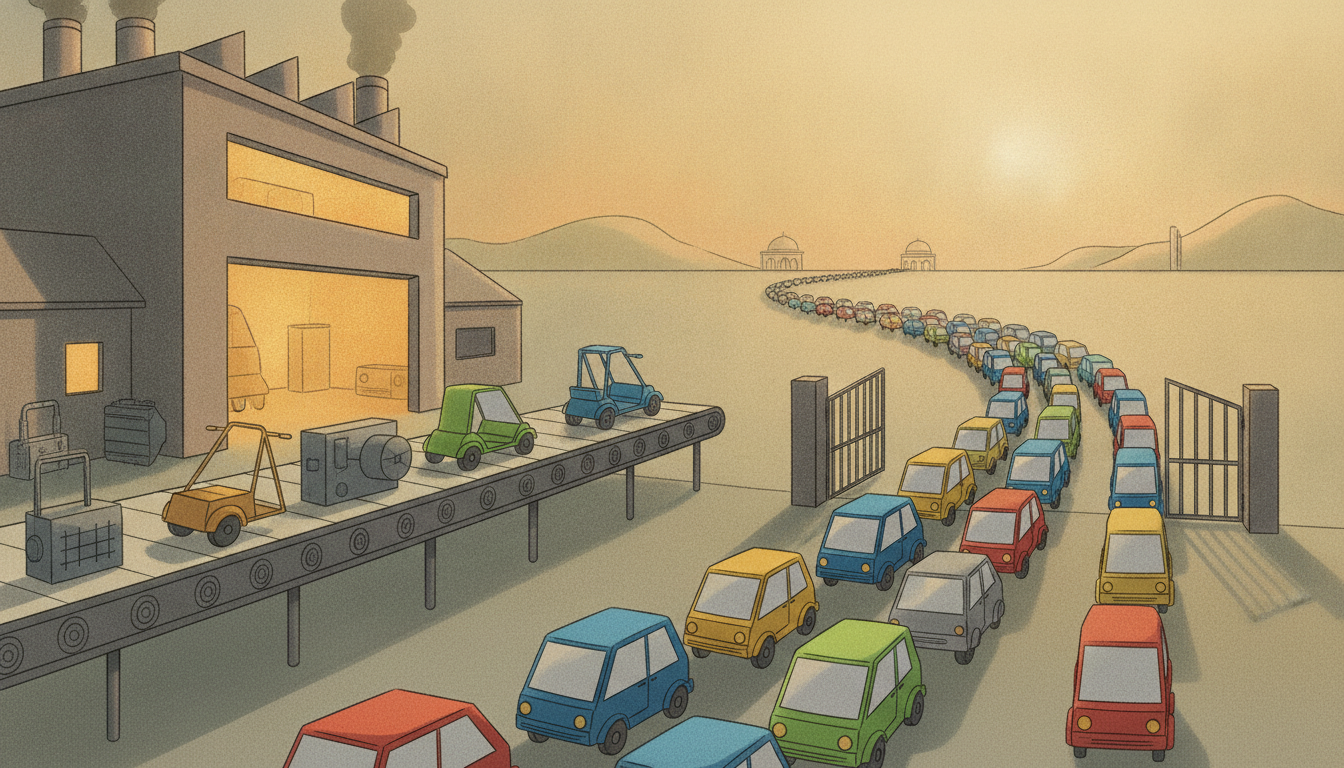
The electric vehicle (EV) industry in India is facing a challenge: more people want to buy EVs than companies can currently produce. This high demand is putting pressure on manufacturers to make more vehicles and improve their supply chains.
Ather Energy, an Indian company that makes electric two-wheelers, recently reported its first quarterly profit in September 2026. The company's revenue grew by 62%, and they sold 42% more units than the previous year. However, Ather Energy's co-founder and CEO, Tarun Mehta, stated that the company cannot meet about 20,000 units of retail demand each month. To fix this, Ather Energy plans to add production capacity for 2.25 lakh (225,000) units per year.
Across India, registrations for electric two-wheelers increased by 82% in the September quarter of 2026, reaching about 5.98 lakh (598,000) units. Electric scooters made up 11.2% of all scooter sales during this time, peaking at 11.6% in September 2026. The adoption of electric three-wheelers is even higher, accounting for 64.9% of registrations in that segment.
Even though EV production across all vehicle types in India increased by almost 40% in the second quarter of 2026, demand is still higher than supply. For example, one company, TMPV, has more than doubled its monthly EV production capacity to over 16,000 units, up from about 7,500-8,000 units last year. However, the company's Managing Director and CEO, Shailesh Chandra, noted in September 2026 that the ability of their suppliers to provide parts is limiting how much more they can expand production.
Knowledge Vault
Supply and Demand
Supply refers to how much of a product or service is available, while demand is how much people want to buy it. When demand is higher than supply, it means many people want something, but there isn't enough of it. This can lead to companies trying to make more of that product.
Production Capacity
Production capacity is the maximum amount of goods a factory or company can make in a certain period. If a company wants to produce more items, it needs to increase its production capacity, which might involve building new factories or buying more machines.
Electric Vehicles (EVs)
Electric vehicles are cars, scooters, or other vehicles that run on electricity instead of petrol or diesel. They use electric motors and batteries. EVs are becoming popular because they can help reduce air pollution.
Check your understanding
- What is the main challenge facing the electric vehicle (EV) industry in India, according to the article?
- There are not enough customers interested in buying EVs.
- Manufacturers are producing too many EVs, leading to a surplus.
- The demand for EVs is growing faster than manufacturers can produce them.
- EVs are too expensive for most people in India.
- What is one way Ather Energy plans to address the high demand for its electric two-wheelers?
- By reducing the price of their electric two-wheelers.
- By focusing primarily on increasing their profits.
- By adding 2.25 lakh units of annual production capacity.
- By stopping the production of electric two-wheelers.
- Which type of electric vehicle had the highest adoption rate in India, with 64.9% of registrations in its segment?
- Electric cars
- Electric two-wheelers
- Electric three-wheelers
- Electric buses