How Do Steam Engines Work?
Steam engines use the power of steam to create movement. They burn fuel to heat water, turning it into high-pressure steam. This steam then pushes parts of the engine, making machines like trains move. Early improvements by James Watt made these engines much more efficient.
By The Junior Post
Explainer · First published
Recommended for ages 8+. Editorial guidance, not a guarantee of individual suitability.
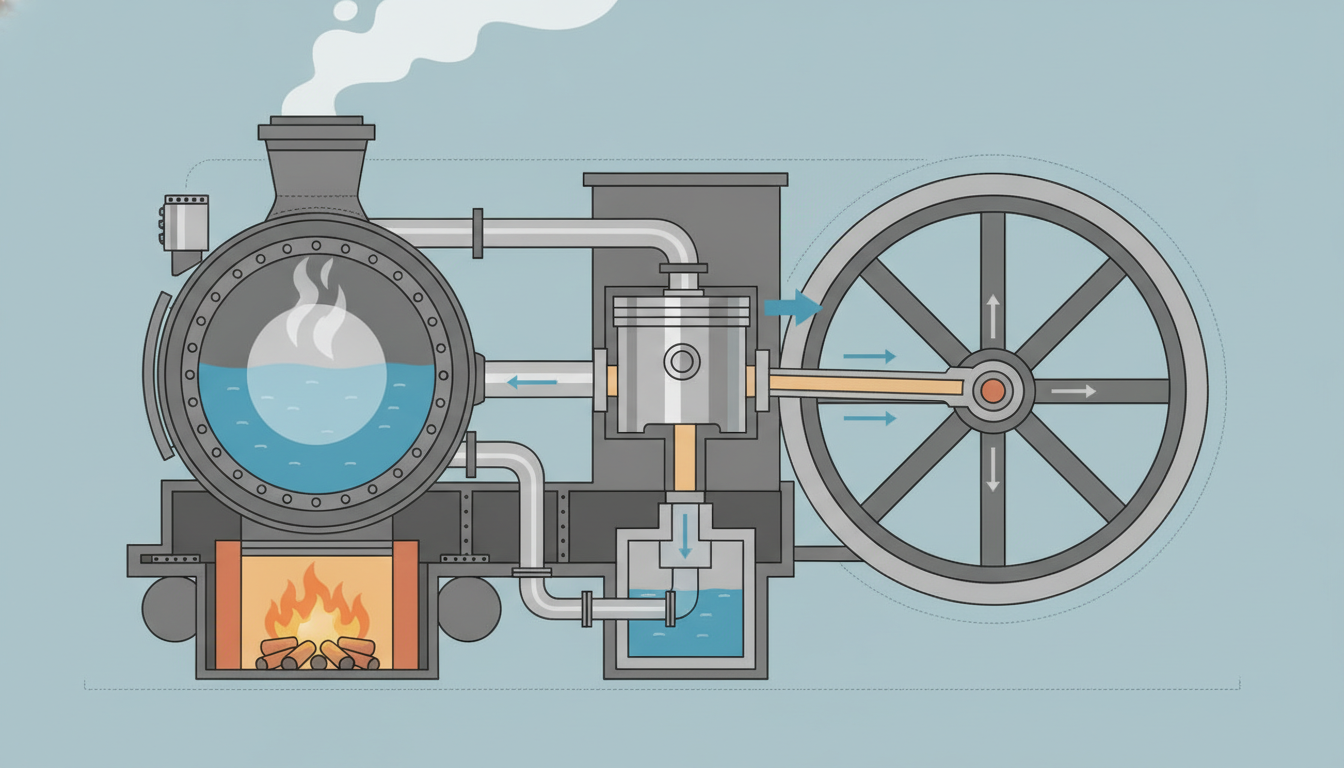
A steam engine works by using the force of steam to create motion. First, fuel, such as coal or wood, is burned in a furnace. This heat boils water in a boiler, turning it into steam.
As the water boils, the steam produced is under high pressure. This high-pressure steam is then directed into a cylinder, where it pushes a piston. The piston is connected to other parts of the engine, like driving wheels on a locomotive, causing them to move.
After the steam has pushed the piston, it can be condensed back into water in a separate apparatus. This process, known as condensation, helps to make the engine more efficient. James Watt made important improvements to steam engine technology between 1763 and 1776, including adding a separate condenser and an insulating jacket for the main cylinder. These changes greatly increased the engine's efficiency and allowed it to be used for many different purposes, not just in mining.
The continuous cycle of heating water, producing steam, using the steam to push parts, and then condensing the steam allows the engine to keep working. This technology was crucial for developing many modern machines and transportation systems.
Knowledge Vault
Energy Transformation
Energy transformation is the process of changing energy from one form to another. In a steam engine, chemical energy stored in the fuel is transformed into heat energy, which then transforms water into steam. The steam's pressure then creates mechanical energy to move the engine. This concept is fundamental to how many machines work.
Efficiency in Machines
Efficiency in machines refers to how well a machine converts the energy it receives into useful work. A more efficient machine wastes less energy, often as heat or sound. James Watt's improvements to the steam engine, like adding a condenser, made it more efficient by reducing wasted heat and allowing more of the steam's energy to be used for work.
The Industrial Revolution
The Industrial Revolution was a period of major changes in how goods were made, starting in the late 1700s. It involved new manufacturing processes, the use of new energy sources like steam, and the growth of factories. The steam engine was a key invention during this time, powering many new machines and leading to significant societal and economic changes.
Check your understanding
- What is the main purpose of burning fuel in a steam engine?
- To make the engine shiny
- To heat water and create steam
- To cool down the engine parts
- To make loud noises
- What did James Watt add to the steam engine to make it more efficient?
- A louder whistle
- A separate condenser and an insulating jacket
- More decorative paint
- Larger wheels
- How does high-pressure steam make a locomotive move?
- It makes the locomotive float
- It pushes pistons connected to the driving wheels
- It cools the engine down
- It makes the engine lighter