India Launches NVS-03 Navigation Satellite with GSLV Mark II Rocket
India successfully launched its NVS-03 navigation satellite on October 30, 2026, using a GSLV Mark II rocket. This satellite is the third in the next-generation series for India's NavIC system, which provides navigation services similar to GPS for India and nearby areas.
By The Junior Post
Published
Recommended for ages 10+. Editorial guidance, not a guarantee of individual suitability.
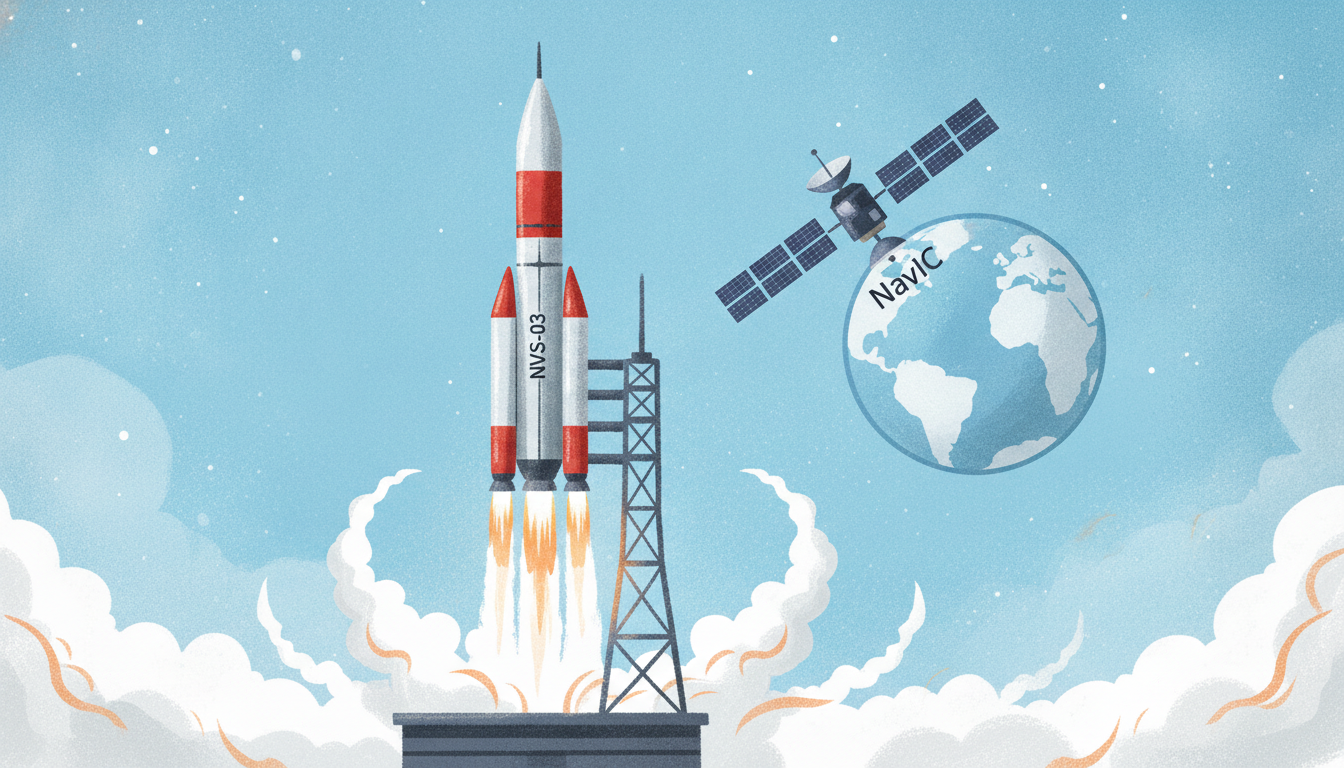
On October 30, 2026, India successfully launched its NVS-03 navigation satellite. The launch happened at 11:51 p.m. India Standard Time from the Satish Dhawan Space Centre. The rocket used for this mission was the GSLV Mark II.
About 30 minutes after the rocket lifted off, officials from the Indian Space Research Organisation (ISRO) confirmed that the satellite was placed into its planned orbit. This was the 14th launch for the GSLV Mark II rocket, which is 52 meters tall and has three stages. Out of these 14 launches, 12 have been successful.
The NVS-03 is the third next-generation satellite for India's Navigation with Indian Constellation (NavIC) system. NavIC is India's own regional navigation satellite system, similar to the Global Positioning System (GPS) used by the United States. Its purpose is to give accurate Position, Navigation, and Timing (PNT) services to users within India and up to about 1,500 kilometers beyond its borders.
This mission was the fourth orbital launch from Indian soil in 2026 and the third one carried out by ISRO this year.
Knowledge Vault
Navigation Satellite Systems
Navigation satellite systems are networks of satellites orbiting Earth that send signals to receivers on the ground. These signals help determine a user's precise location, speed, and time anywhere on or near the Earth. Examples include India's NavIC and the United States' GPS.
Geostationary Transfer Orbit
A geostationary transfer orbit (GTO) is a special path in space that a satellite takes after launch. It's an elliptical (oval-shaped) orbit that helps a satellite reach its final geostationary orbit, where it appears to stay in the same position over the Earth. This is useful for communication and navigation satellites.
Check your understanding
- What is the main purpose of India's NavIC system?
- To provide weather forecasts for farmers across India.
- To offer accurate Position, Navigation, and Timing services.
- To help scientists study distant galaxies.
- To broadcast television channels to remote areas.
- Which rocket was used to launch the NVS-03 satellite?
- Global Positioning System (GPS) rocket
- Satish Dhawan Space Centre rocket
- GSLV Mark II rocket
- Navigation with Indian Constellation (NavIC) rocket
- How is NavIC similar to the United States' Global Positioning System (GPS)?
- Both systems are used for sending messages to astronauts in space.
- Both systems are designed to provide navigation services.
- Both systems are built by the same space agency.
- Both systems are only used for military purposes.