Indian Government Reduces Prices of Many Cancer Drugs
The Indian government has announced that the prices of many cancer drugs will be reduced, following a Supreme Court ruling that called high mark-ups "extortion." This decision, effective next month, aims to make treatment more affordable for patients across the country.
By The Junior Post
Published
Recommended for ages 10+. Editorial guidance, not a guarantee of individual suitability.
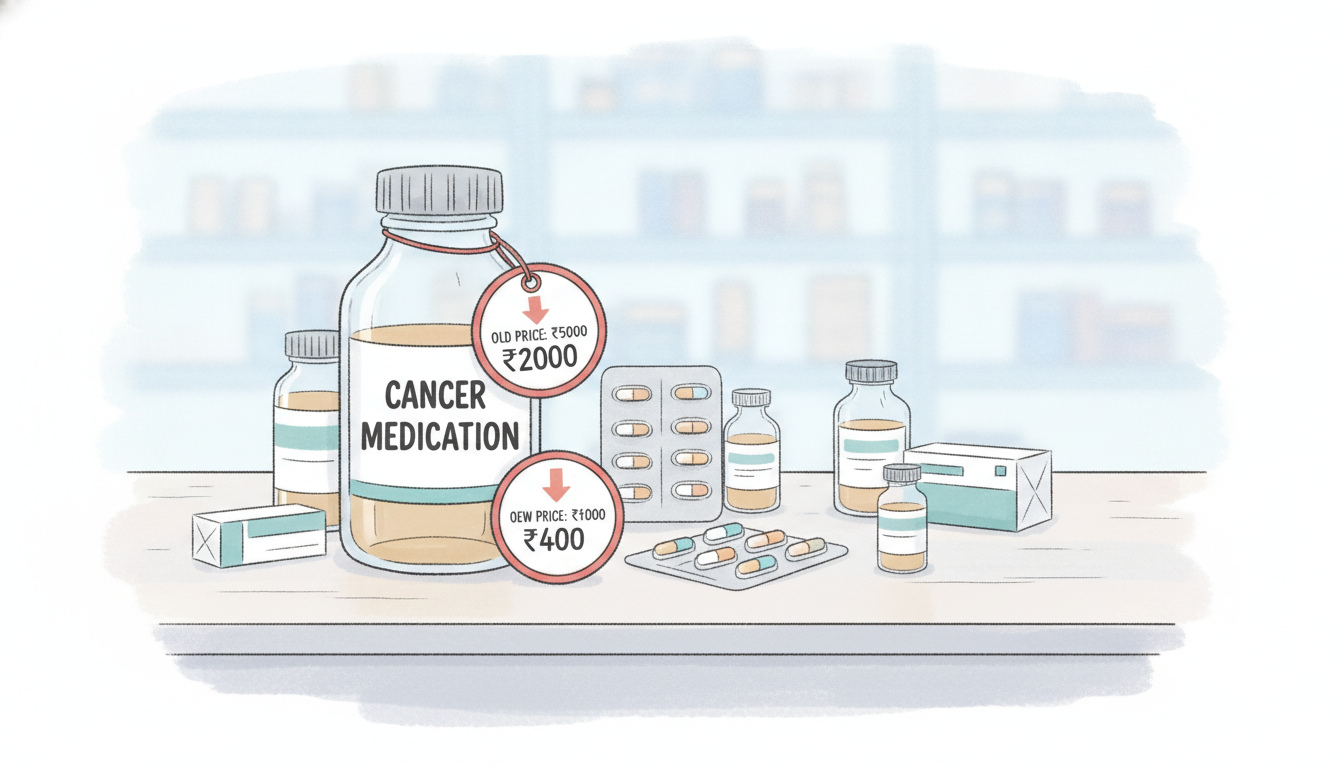
The Indian government has decided to reduce the prices of 137 cancer drugs, with the changes set to begin next month. This move follows a ruling by the Supreme Court, which described very high price increases on these medicines as "extortion."
The Supreme Court's involvement came after a petition was filed in 2022 by Sarojam Radhakrishnan, a retired bank clerk from Kerala. She had been diagnosed with breast cancer in 2021 and found it hard to pay for her medication.
During a court hearing on September 29, justices Vikram Nath and Sandeep Mehta pointed out an example where a vital cancer drug was sold to hospitals for 2,700 rupees but then sold to patients for 27,000 rupees. This showed a very large difference in price.
An analysis by the National Pharmaceutical Pricing Authority (NPPA) found that the extra money added to the price of some cancer drugs, called trade mark-ups, was often around 170%. In some extreme cases, these mark-ups were more than 700%.
On October 17, the NPPA decided to limit these trade mark-ups to 30% of the Maximum Retail Price (MRP) for 137 non-scheduled anti-cancer drugs. This action is expected to lower medicine prices by up to 70% and could save cancer patients about 2,500 crore rupees each year.
As a result, the maximum retail prices of 543 cancer drug brands have been changed, with some prices dropping by over 90% starting November 9, 2026. For example, the price of Palbociclib, used for certain breast cancers, has been reduced significantly for one brand and pack size. Other drugs like Thiotepa, Dasatinib, Lenvatinib, Abiraterone, and Olaparib have also seen price cuts. However, some very expensive cancer medicines, including certain immunotherapy drugs, have not had their prices changed.
Knowledge Vault
Maximum Retail Price (MRP)
The Maximum Retail Price (MRP) is the highest price that can be charged for a product in India. It is printed on the packaging of most products. Sellers cannot charge more than the MRP, but they can sell for less. This helps protect consumers from being overcharged.
Trade Margin
A trade margin is the difference between the price at which a product is sold by a manufacturer to a distributor or retailer, and the price at which the distributor or retailer sells it to the customer. It covers the costs and profit for the people who sell the product.
National Pharmaceutical Pricing Authority (NPPA)
The National Pharmaceutical Pricing Authority (NPPA) is a government organization in India. Its main job is to control the prices of medicines, especially essential ones, to make sure they are affordable for everyone. They do this by setting price limits and monitoring drug prices.
Check your understanding
- What was a key reason the Indian government decided to reduce the prices of many cancer drugs?
- A new type of cancer was discovered that required cheaper medicine.
- The Supreme Court ruled that very high price increases on drugs were "extortion."
- Pharmaceutical companies voluntarily decided to lower prices.
- A global agreement was signed to make all medicines free.
- Who filed the petition in 2022 that brought attention to the high cost of cancer medication?
- The National Pharmaceutical Pricing Authority (NPPA)
- A group of doctors from Delhi
- Sarojam Radhakrishnan, a retired bank clerk
- The Indian government itself
- What action did the National Pharmaceutical Pricing Authority (NPPA) take to help reduce drug prices?
- They stopped the sale of all cancer drugs.
- They capped trade margins at 30% of the Maximum Retail Price for certain drugs.
- They started manufacturing all cancer drugs themselves.
- They asked patients to find cheaper alternatives abroad.