Mumbai's Air Quality Worsens, Ranked Among Most Polluted Cities
Mumbai's air quality has recently worsened, with reports on October 25, 2026, indicating an Air Quality Index (AQI) of 269, classified as "Severe." This follows earlier reports in October that ranked Mumbai as one of the most polluted cities globally, raising concerns for sensitive groups like children and those with breathing issues.
By The Junior Post
Published
Recommended for ages 8+. Editorial guidance, not a guarantee of individual suitability.
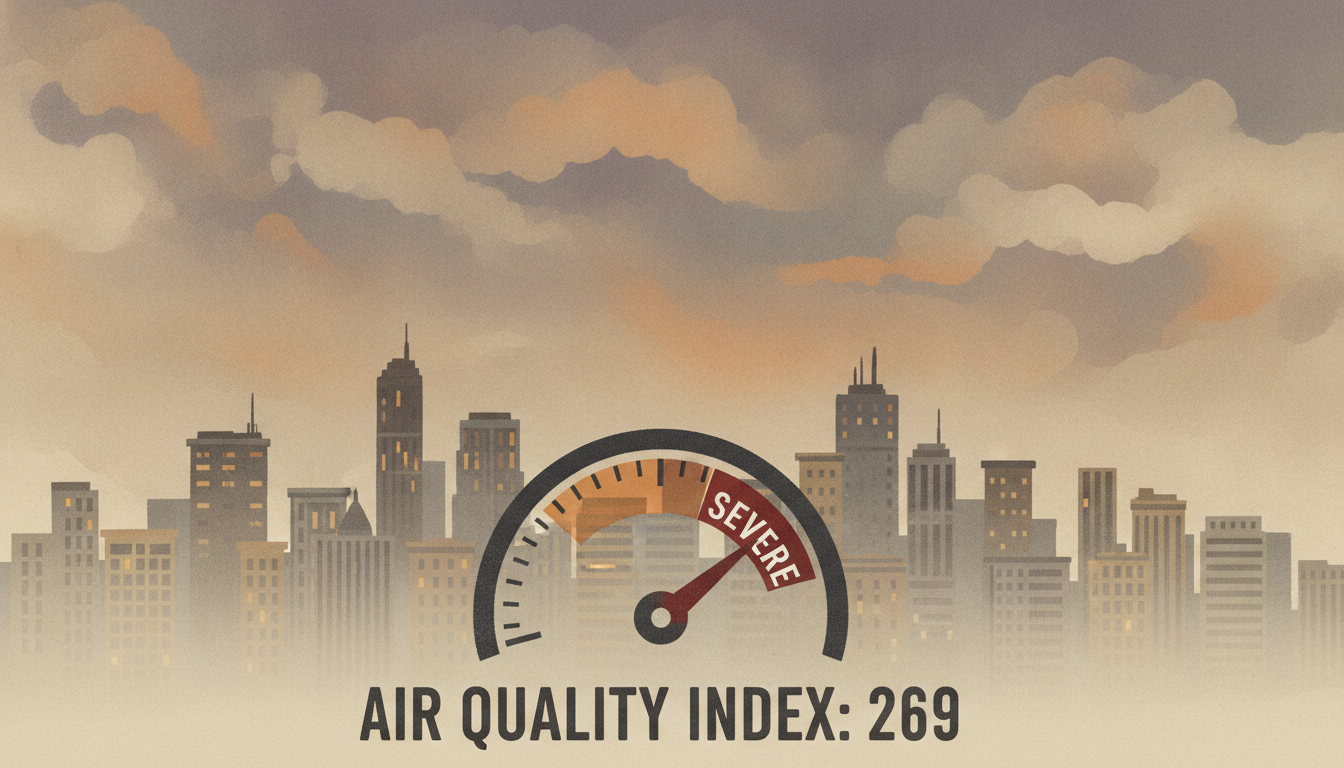
Mumbai's air quality has been a growing concern, with recent reports showing a significant increase in pollution levels. As of October 25, 2026, the city's Air Quality Index (AQI) was recorded at 269, which is categorized as "Severe." This level of pollution suggests that everyone, especially sensitive groups like children or individuals with breathing problems, should be very careful and limit their time outside.
Earlier in October, on October 16, 2026, Mumbai was identified as the fifth most polluted city in the world and the most polluted in India, according to iQAir, a US-based air quality monitoring group. On that day, the AQI was 152, considered "unhealthy." Ground-level ozone was noted as the main pollutant during a period of unusually hot and humid weather, after the monsoon season ended early.
The situation reportedly worsened by October 20, 2026, when iQAir ranked Mumbai as the third most polluted city globally, with an AQI of 166. While the Central Pollution Control Board (CPCB) reported Mumbai's AQI as 114, also in the unhealthy category, it was noted that private organizations like iQAir use real-time sensors that can show sudden pollution increases more quickly than government bodies.
When the AQI is "Poor" or higher, it is recommended to reduce outdoor activities. Wearing a mask when outside can also help. These measures are important to protect health when air quality is low.
Knowledge Vault
Air Quality Index (AQI)
The Air Quality Index (AQI) is a number used to tell people how clean or polluted the air is, and what health effects might be a concern. A higher AQI value means greater air pollution and a greater health concern. Different numbers on the AQI scale correspond to different levels of air quality, like "Good," "Moderate," "Unhealthy," or "Severe."
Ground-level Ozone (O3)
Ground-level ozone is a harmful air pollutant that forms when gases from cars, power plants, and other sources react with sunlight. Unlike the ozone layer high in the atmosphere that protects us from the sun, ground-level ozone is bad for breathing and can cause health problems, especially for people with lung conditions.
Air Quality Monitoring
Air quality monitoring involves regularly checking the air for different pollutants. This is done using special equipment at monitoring stations. The information collected helps scientists and governments understand pollution levels, identify sources of pollution, and warn people when the air is unhealthy. Both government and private organizations conduct this monitoring.
Check your understanding
- What was Mumbai's Air Quality Index (AQI) reported as on October 25, 2026?
- 100
- 152
- 269
- 322
- According to iQAir, what was Mumbai's global ranking for pollution on October 20, 2026?
- First
- Third
- Fifth
- Tenth
- What is generally advised when the Air Quality Index (AQI) is "Poor" or higher?
- Increase outdoor activities
- Go for a long run
- Reduce outdoor activities and consider wearing a mask
- It is safe for everyone to be outside without precautions