Orionid Meteor Shower: How to Watch Debris from Halley's Comet
The Orionid meteor shower, caused by dust and ice from Halley's Comet, is expected to be visible. These fast-moving meteors can be seen in both the Northern and Southern Hemispheres, especially after midnight. While moonlight might reduce visibility during the peak, there will be a dark window before dawn for viewing. Finding a spot away from city lights is recommended for the best experience.
By The Junior Post
Published · Updated
Recommended for ages 8+. Editorial guidance, not a guarantee of individual suitability.
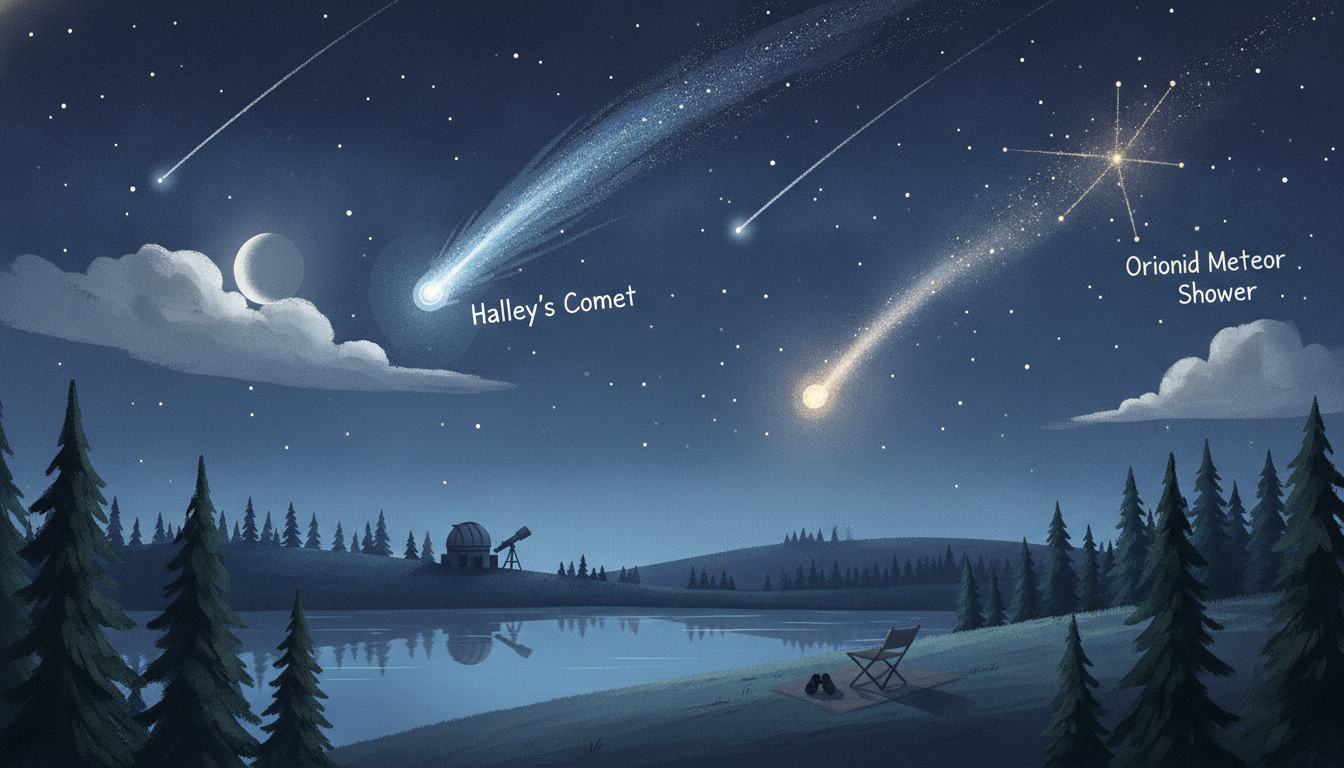
Get ready for a special light show in the night sky! It's called the Orionid meteor shower. This shower happens when Earth passes through a trail of dust and ice left behind by a famous comet named Halley's Comet. Think of it like a car driving through a cloud of glitter.
These tiny pieces, called meteors, travel very fast, about 66 kilometers every second! When they hit Earth's air, they get very hot and glow, making bright streaks of light. Sometimes, these streaks can even leave a glowing trail that lasts for a few seconds.
You can see these meteors in both the top half (Northern Hemisphere) and bottom half (Southern Hemisphere) of the world. The best time to look is after midnight, when the sky is darkest. It's like staying up late for a special event!
The meteors will seem to come from an area in the sky where the constellation Orion is. A constellation is a group of stars that looks like a picture. Orion rises in the east after midnight in October.
There will be a bright moon in the sky during the peak of the shower. This bright moon might make it harder to see the fainter meteors. But don't worry, the moon will set later in the night, giving you a darker time to watch before the sun comes up.
To see the most meteors, try to find a place far away from city lights. City lights make the sky too bright, like trying to see stars when a flashlight is shining in your eyes. If you can't get away from city lights, sometimes NASA shows the meteor shower live online!
Knowledge Vault
Meteor Showers
A meteor shower occurs when Earth passes through a stream of cosmic debris left by a comet or asteroid. As these small particles, called meteoroids, enter Earth's atmosphere, they burn up due to friction, creating bright streaks of light known as meteors or 'shooting stars'. The point from which these meteors appear to originate in the sky is called the radiant, and it gives the shower its name, often associated with a constellation.
Comets
Comets are icy, small solar system bodies that, when passing close to the Sun, warm up and begin to outgas, displaying a visible atmosphere or coma, and sometimes also a tail. These phenomena are due to the effects of solar radiation and the solar wind acting upon the comet's nucleus. The debris shed by comets, like Halley's Comet, can lead to meteor showers when Earth's orbit intersects with these trails.
Light Pollution
Light pollution is the excessive or inappropriate use of artificial light. It has several negative environmental consequences, including obscuring the night sky, which makes it difficult to observe celestial objects like stars and meteor showers. City lights scatter into the atmosphere, creating a glow that washes out fainter astronomical phenomena. To combat this, astronomers and skygazers seek out dark sky locations, far from urban areas.
Check your understanding
- What causes the Orionid meteor shower?
- Pieces of a broken planet
- Dust and ice from Halley's Comet
- Lights from distant galaxies
- Reflections from the moon
- When is the best time to look for the Orionid meteors?
- Right after sunset
- During the middle of the day
- After midnight and before dawn
- Anytime the sky is clear
- What might make it harder to see the meteors during the peak?
- Too many clouds
- A very bright moon
- Other stars being too bright
- The meteors moving too slowly