Protests Across France: Thousands March, Police Respond to Clashes
Thousands of people across France participated in demonstrations, with police reporting a nationwide turnout of 410,000. While some marches began peacefully, authorities used tear gas and water cannons in several cities, including Paris, Lyon, and Nantes, to disperse crowds after some protesters reportedly threw objects.
By The Junior Post
Published
Recommended for ages 10+. Editorial guidance, not a guarantee of individual suitability.
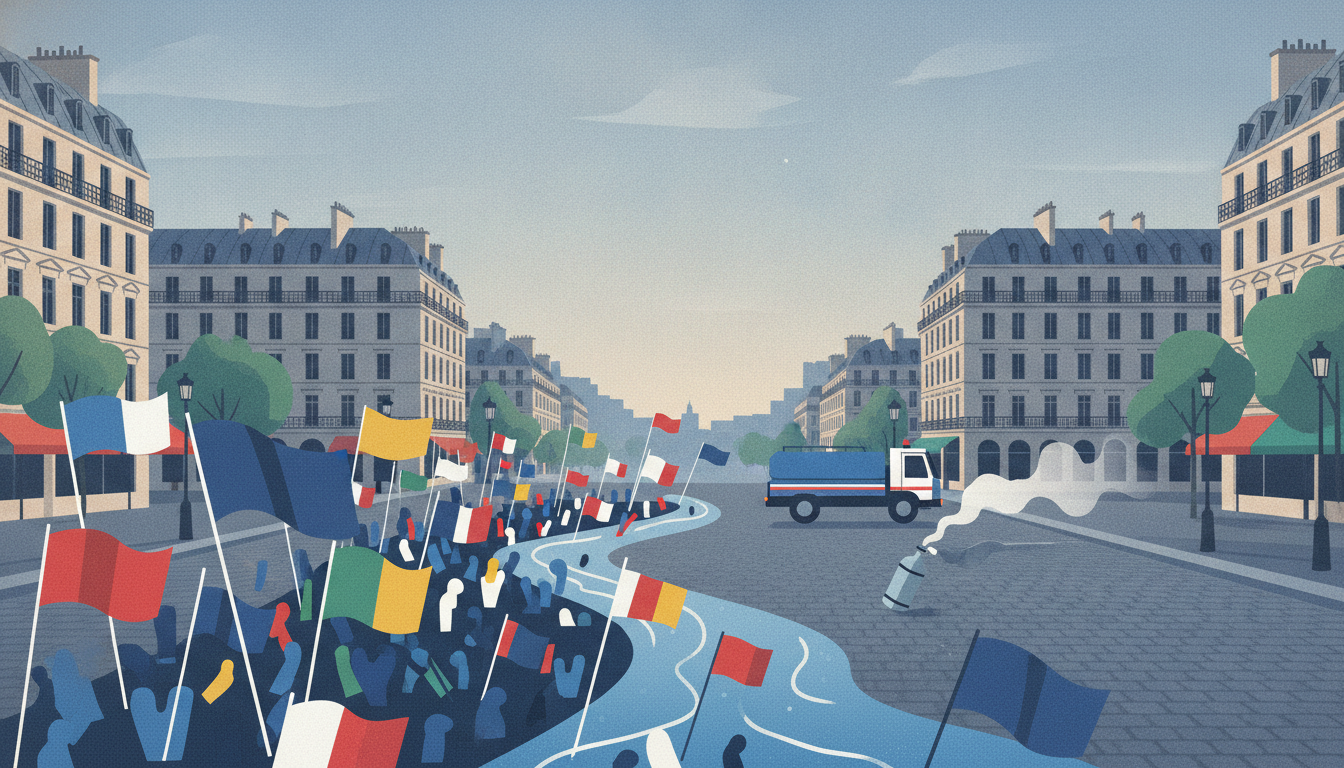
On October 24, 2026, thousands of people marched in cities across France. The Interior Ministry reported that about 410,000 people participated nationwide. In Paris, around 110,000 people joined the march, which police initially described as "calm."
However, near the end of the Paris march at Porte de Vincennes, some protesters reportedly threw objects. In response, police used tear gas and water cannons to break up the crowds. Authorities had kept the Paris march to the southeastern edge of the city, away from central areas that had seen damage in previous weeks.
Similar situations occurred in other French cities. Police used tear gas in Lyon, Clermont-Ferrand, Strasbourg, Lille, and Toulouse. Water cannons were deployed in Nice and Nantes. In Marseille, tear gas was used during clashes involving several dozen people near the end of a march.
The Paris prosecutor's office reported 64 arrests linked to the demonstration in the capital, with 40 people taken into police custody, including six minors. Most arrests were for suspected weapons offenses or for being part of groups preparing violence or property damage. Paris police also stated that over 3,000 people were stopped and checked by officers.
Before the demonstrations, Interior Minister Laurent Nuñez warned that authorities would not tolerate violence or disturbances to public order. Many shop windows in Paris were boarded up, and some larger stores closed for the day due to the planned protests. In Orleans, thousands also marched against both President Emmanuel Macron and Marine Le Pen, whose party was holding a congress there.
Knowledge Vault
Public Order
Public order refers to the general peace, safety, and good behavior that is expected in a community. When people gather for protests, authorities try to maintain public order to prevent violence or damage, ensuring everyone's safety.
Tear Gas
Tear gas is a chemical substance used by police to control crowds. It causes temporary irritation to the eyes, nose, mouth, and skin, making it difficult for people to stay in an area. It is used to disperse large groups when there is a risk of violence or disorder.
Water Cannons
Water cannons are devices that spray powerful jets of water. Police use them to disperse large crowds during protests or riots. The force of the water can push people back and help to break up gatherings that are becoming disorderly or violent.
Check your understanding
- What was the reported nationwide turnout for the demonstrations in France?
- 110,000 people
- 410,000 people
- 64 people
- 3,000 people
- What actions did police take in response to some protesters throwing objects in Paris?
- They offered free food and water.
- They used tear gas and water cannons.
- They closed all shops immediately.
- They joined the march.
- What was a reason for some shops in Paris to be boarded up or closed?
- They were undergoing renovations.
- They were celebrating a holiday.
- To protect against potential violence or property damage during demonstrations.
- They ran out of products to sell.