Understanding India's Legislative Councils and MLC Elections
In India, Members of the Legislative Council (MLCs) are chosen through a unique system that involves different groups of voters, not just the general public. These councils act as an upper house in some state legislatures, helping to review and discuss laws.
By The Junior Post
Published
Recommended for ages 12+. Editorial guidance, not a guarantee of individual suitability.
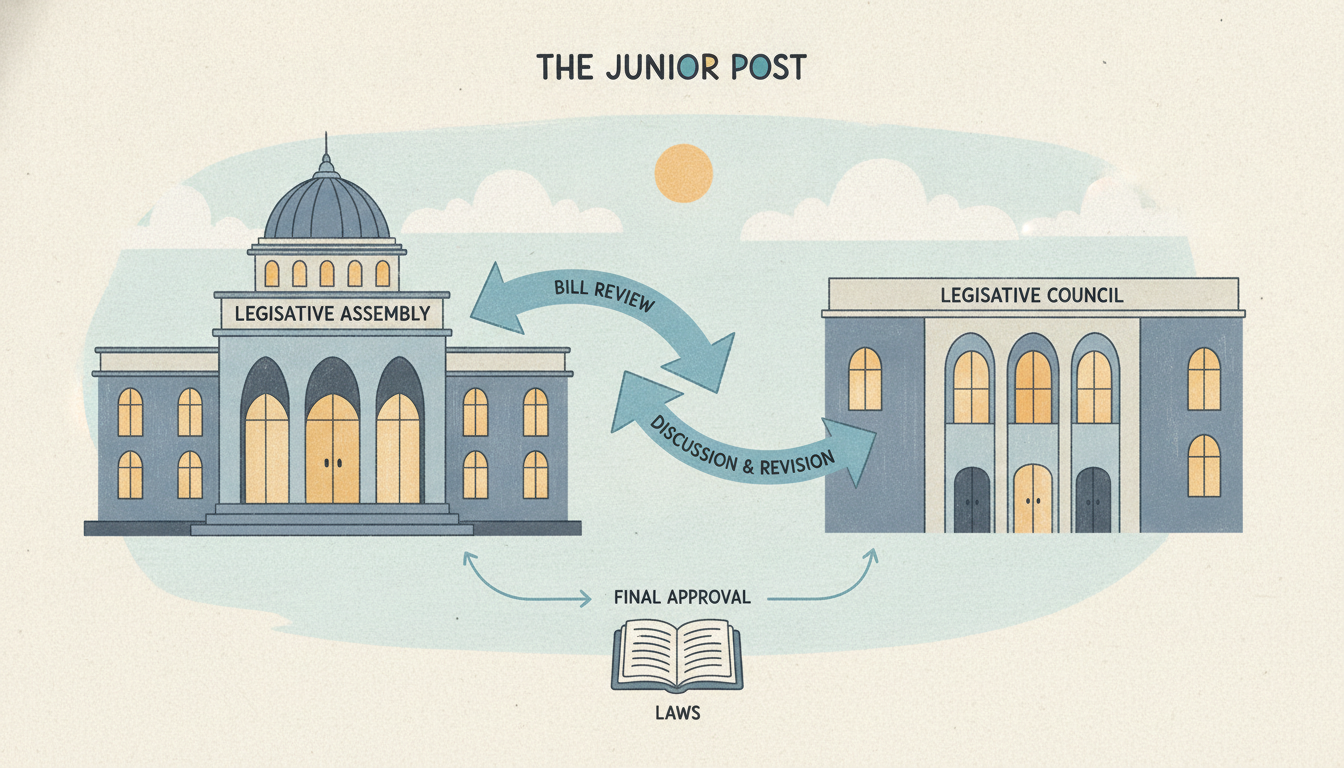
A Member of the Legislative Council (MLC) sits in the Vidhan Parishad, which is the upper house of a state legislature. This is similar to how the Rajya Sabha is the upper house at the national level. Not all states in India have a Legislative Council; only some do.
The way MLCs are elected is different from how Members of the Legislative Assembly (MLAs) are chosen. Most ordinary voters do not directly elect MLCs. Instead, MLCs are chosen through five different methods.
About one-third of MLCs are elected by MLAs, who are already members of the state's lower house. Another one-third are elected by members of local bodies, such as panchayats, municipalities, and corporations. A smaller portion, about one-twelfth, are elected by registered graduates who have held a degree for at least three years and are enrolled on a special voters' list. Another one-twelfth are elected by registered teachers.
The remaining MLCs are nominated by the Governor of the state. This means that only graduates and teachers who have specifically registered for these elections can directly vote for an MLC. For most citizens, voting for an MLC is not a direct process.
The Legislative Council is a permanent body, meaning it is never fully dissolved. Instead, about one-third of its members retire every two years, leading to biennial elections. MLCs serve for six-year terms. The Council's strength cannot be more than one-third of the Legislative Assembly's strength and must be at least 40 members, as stated in Article 171 of the Constitution.
The Legislative Council's main role is to provide an extra layer of discussion and review for laws. It can examine bills, suggest changes, and raise concerns before laws are finalized. However, its powers are not as extensive as those of the Legislative Assembly. For example, the Legislative Council cannot permanently block an ordinary bill that has been passed by the Legislative Assembly; the Assembly can override the Council's objections.
Knowledge Vault
Legislative Council (Vidhan Parishad)
The Legislative Council, also known as Vidhan Parishad, is the upper house of the state legislature in some Indian states. It serves as a 'second layer' for reviewing and discussing laws. Unlike the Legislative Assembly, its members are not directly elected by all adult citizens. It is a permanent body, meaning it is never fully dissolved, with members serving six-year terms and about one-third retiring every two years.
Member of Legislative Council (MLC)
An MLC is a representative who sits in the Legislative Council (Vidhan Parishad) of a state. MLCs are chosen through a special electoral process involving MLAs, members of local bodies, registered graduates, and registered teachers, with some also nominated by the Governor. They play a role in examining bills and suggesting changes.
Biennial Elections
Biennial elections are elections that happen every two years. In the context of India's Legislative Councils, these elections are held to replace the one-third of members who retire every second year, ensuring the Council remains a continuous, permanent body.
Check your understanding
- Which of the following groups can directly vote for a Member of the Legislative Council (MLC) in India?
- All adult citizens of the state
- Members of the Legislative Assembly (MLAs)
- Registered graduates and teachers
- Only the Governor of the state
- What is a key characteristic of a Legislative Council (Vidhan Parishad) in India?
- It is dissolved completely every five years.
- Its members are all nominated by the President of India.
- It is a permanent house, with about one-third of its members retiring every two years.
- It has more power than the Legislative Assembly in all matters.
- What is the primary role of a State Legislative Council?
- To permanently block any bill passed by the Legislative Assembly.
- To elect the Chief Minister of the state.
- To provide an additional forum for discussing and reviewing laws.
- To directly manage the state's finances and budget.