Why Do Volcanoes Form in Specific Places?
Volcanoes, which are openings in the Earth's surface that release molten rock, usually form in specific areas where large pieces of the Earth's crust, called tectonic plates, meet. These areas are often where plates are moving towards or away from each other, or sometimes over hot spots deep within the Earth.
By The Junior Post
Explainer · First published
Recommended for ages 10+. Editorial guidance, not a guarantee of individual suitability.
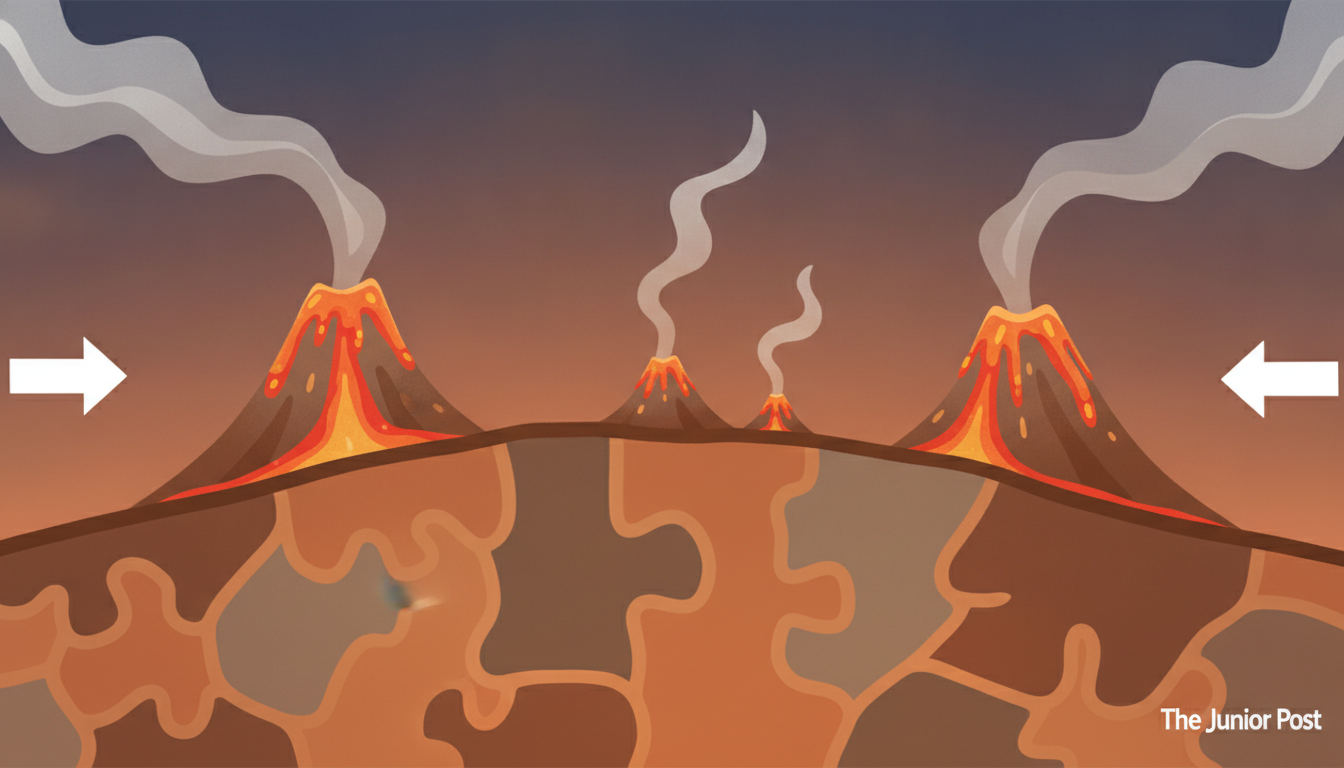
Volcanoes form when magma, which is molten rock from deep inside the Earth, rises to the surface. When this magma erupts, it becomes lava. Most volcanoes are found along plate margins, which are the areas where two or more tectonic plates meet. These plates are large sections of the Earth's crust that are constantly moving.
One way volcanoes form is at a constructive margin, where two plates move away from each other. As the plates separate, magma rises up to fill the gaps, creating new crust and sometimes volcanoes. Another common way is at a destructive margin, where two plates move towards each other. Here, one plate, often an oceanic crust, is forced to sink beneath another plate, usually a continental crust. This process is called subduction.
As the oceanic crust sinks deeper into the Earth's hot interior, it melts and creates new magma. This magma is less dense than the surrounding rock, so it rises towards the surface and can erupt to form volcanoes. These types of volcanoes often have steep sides and can erupt explosively. About four-fifths of the Earth's active volcanoes are found near these destructive plate boundaries.
Not all volcanoes form at plate margins. Some, like Mount Nyiragongo in Africa, are formed over mantle plumes. A mantle plume is an area where magma rises from deep within the Earth, and it is much hotter than the surrounding mantle rock. Mount Nyiragongo is also part of the East African Rift, where the African tectonic plate is slowly tearing apart.
The composition of lava can vary, affecting how fast it flows. For example, Mount Nyiragongo's lava has very little silica, a compound that makes lava sticky. This low silica content allows its lava to flow unusually fast. Living near volcanoes can have benefits, such as access to geothermal energy, which uses the Earth's heat to power cities.
Knowledge Vault
Tectonic Plates
The Earth's outermost layer, called the lithosphere, is broken into several large and small pieces known as tectonic plates. These plates are constantly moving, though very slowly, across the Earth's surface. Their movements cause many geological events, including earthquakes, mountain formation, and volcanic activity.
Plate Margins
Plate margins are the boundaries where tectonic plates meet. These areas are zones of intense geological activity because the plates are interacting. There are different types of plate margins: constructive (where plates move apart), destructive (where plates move towards each other and one sinks), and transform (where plates slide past each other horizontally).
Subduction
Subduction is a geological process that occurs at destructive plate margins. It is when one tectonic plate, typically an oceanic plate, is forced to slide beneath another plate (either oceanic or continental) and sink into the Earth's mantle. This process can lead to the formation of volcanoes and earthquakes.
Check your understanding
- What is the main reason why most volcanoes form in specific areas?
- Because those areas have the most rainfall.
- Because tectonic plates are interacting there, either moving towards or away from each other.
- Because the Earth's surface is always flat in those locations.
- Because there are many rivers in those areas.
- What happens at a 'destructive margin' that can lead to volcano formation?
- Two plates slide past each other horizontally, causing earthquakes but no volcanoes.
- Two plates move away from each other, and magma rises to fill the gap.
- One plate is forced to sink beneath another, creating magma that rises to form a volcano.
- The Earth's crust becomes very thin, allowing water to seep in and create steam.
- According to Chiara Maria Petrone, what makes Mount Nyiragongo's lava flow unusually fast?
- The volcano is located near the ocean, which cools the lava quickly.
- The lava has a high amount of silica, making it very fluid.
- The lava has very little silica, which normally makes lava sticky.
- The volcano is very tall, so gravity pulls the lava down faster.