
Antarctic Ozone Hole in 2023: One of the Largest in Decades
Scientists observed that the ozone hole over Antarctica in 2023 grew to one of its largest sizes in nearly 50 years. While this might sound concerning, experts confirm that the Earth's protective ozone layer is still on track for a long-term recovery, thanks to global efforts to ban harmful chemicals. The unusual size that year was mainly due to specific weather conditions over the South Pole.
By The Junior Post
Published
Recommended for ages 10+. Editorial guidance, not a guarantee of individual suitability.
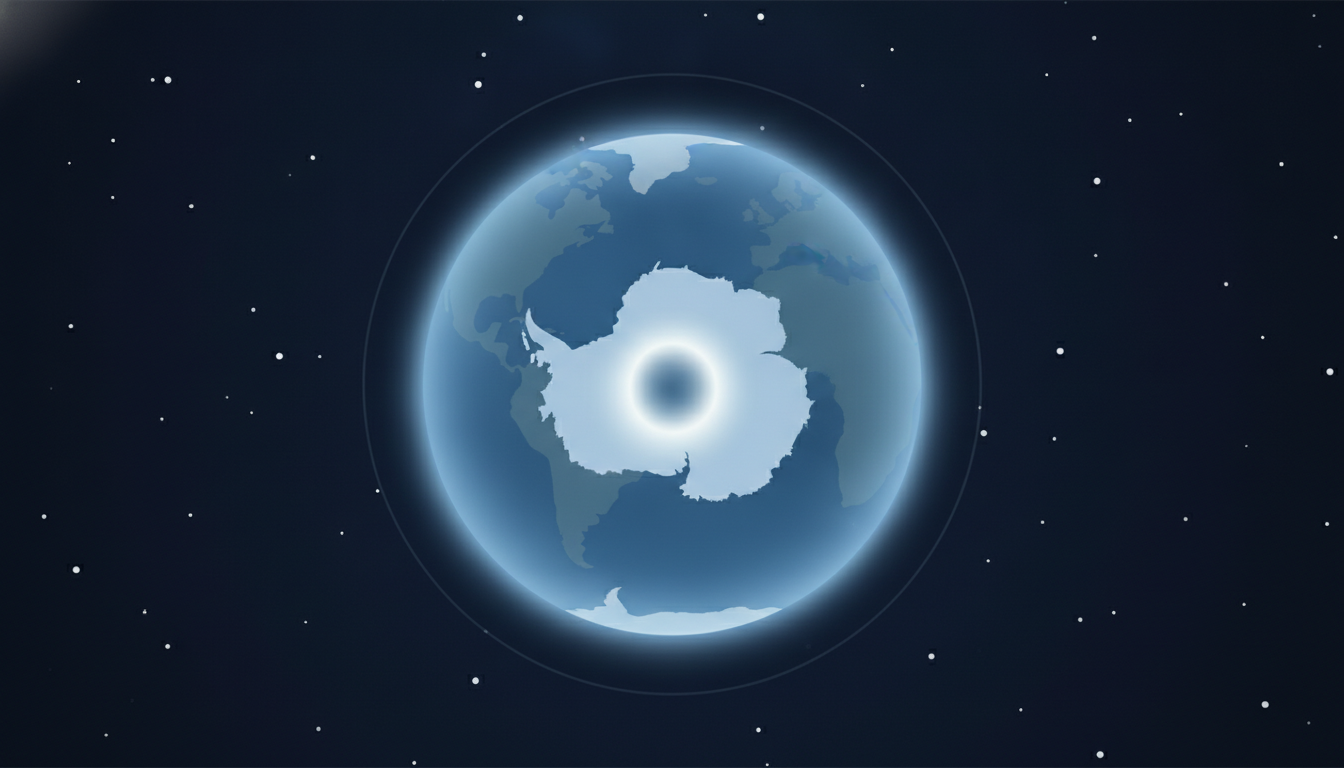
The protective ozone layer high above Antarctica saw one of its largest 'holes' in nearly five decades during 2023. This thinning area, which isn't a literal hole but a region where ozone levels drop significantly, reached an impressive size of about 27.3 million square kilometers on September 20, 2023. This area is larger than the entire continent of Antarctica itself!
Scientists from the European Space Agency (ESA), NASA, and the U.S. National Oceanic and Atmospheric Administration (NOAA) closely monitored this development. They reported that the 2023 ozone hole ranked as the seventh-largest in 48 years of observations, and the largest seen in a decade.
So, why did it get so big that year? Experts believe an unusually strong and long-lasting 'polar vortex' played a key role. This is a large swirl of cold winds that traps air over Antarctica, keeping temperatures very low in the stratosphere. These cold conditions are perfect for chemicals that destroy ozone to become active for a longer time.
The ozone layer is super important because it acts like Earth's natural sunscreen. It absorbs most of the Sun's harmful ultraviolet (UV) radiation, which can cause sunburn, skin cancer, and eye problems like cataracts in humans. Too much UV light can also harm plants and tiny ocean creatures called plankton, which are vital for the marine food chain.
For many years, chemicals called chlorofluorocarbons (CFCs), once found in things like old refrigerators, air conditioners, and spray cans, were the main culprits behind ozone depletion. When these chemicals reached the stratosphere, they broke down and released chlorine atoms that destroyed ozone molecules.
However, there's good news! In 1987, countries around the world signed an important agreement called the Montreal Protocol. This treaty aimed to stop the production and use of ozone-depleting substances. Thanks to these global efforts, the amount of harmful chemicals in the atmosphere has been decreasing.
Even with the larger size of the ozone hole in 2023, scientists are confident that the ozone layer is still slowly healing. They predict that the ozone layer over Antarctica could return to its 1980 levels by around 2066. This shows that when people work together, we can make a big difference in protecting our planet.
Knowledge Vault
The Ozone Layer and Its Importance
The ozone layer is a region within Earth's stratosphere that contains a high concentration of ozone gas (O3). This layer is crucial because it absorbs most of the Sun's harmful ultraviolet (UV) radiation, preventing it from reaching the Earth's surface. Without this protection, increased UV exposure could lead to health problems for humans, such as skin cancer and cataracts, and damage to ecosystems, including plants and marine life.
Quick check
Three questions
Check your understanding with three questions about this story.
Practice for fun. Ask a parent to create a free family account to save your scores and badges.
What is the main role of the ozone layer?
- To absorb harmful ultraviolet (UV) radiation from the Sun.
- To help plants grow faster.
- To make the sky blue.
- To create wind and weather patterns.
What was the primary cause of the ozone layer thinning?
- Natural changes in Earth's temperature.
- Chemicals like chlorofluorocarbons (CFCs) released by human activities.
- Too much sunlight hitting the Earth.
- Large volcanic eruptions.
What international agreement helped to address the problem of ozone depletion?
- The Paris Agreement.
- The Kyoto Protocol.
- The Montreal Protocol.
- The Geneva Convention.
Choose your answers and check your score in the interactive quiz when it finishes loading.