
Rajasthan Panchayat Election Results 2026: Counting Underway for Zila Parishad and Panchayat Samiti Seats
Today, November 20, 2026, marks a significant day for rural democracy in Rajasthan as the counting of votes for the Zila Parishad and Panchayat Samiti elections is underway. Citizens can follow the results for these crucial local bodies, as well as previously declared Sarpanch and Ward Panch winners, on the official website of the Rajasthan State Election Commission.
By The Junior Post
Published
Recommended for ages 10+. Editorial guidance, not a guarantee of individual suitability.
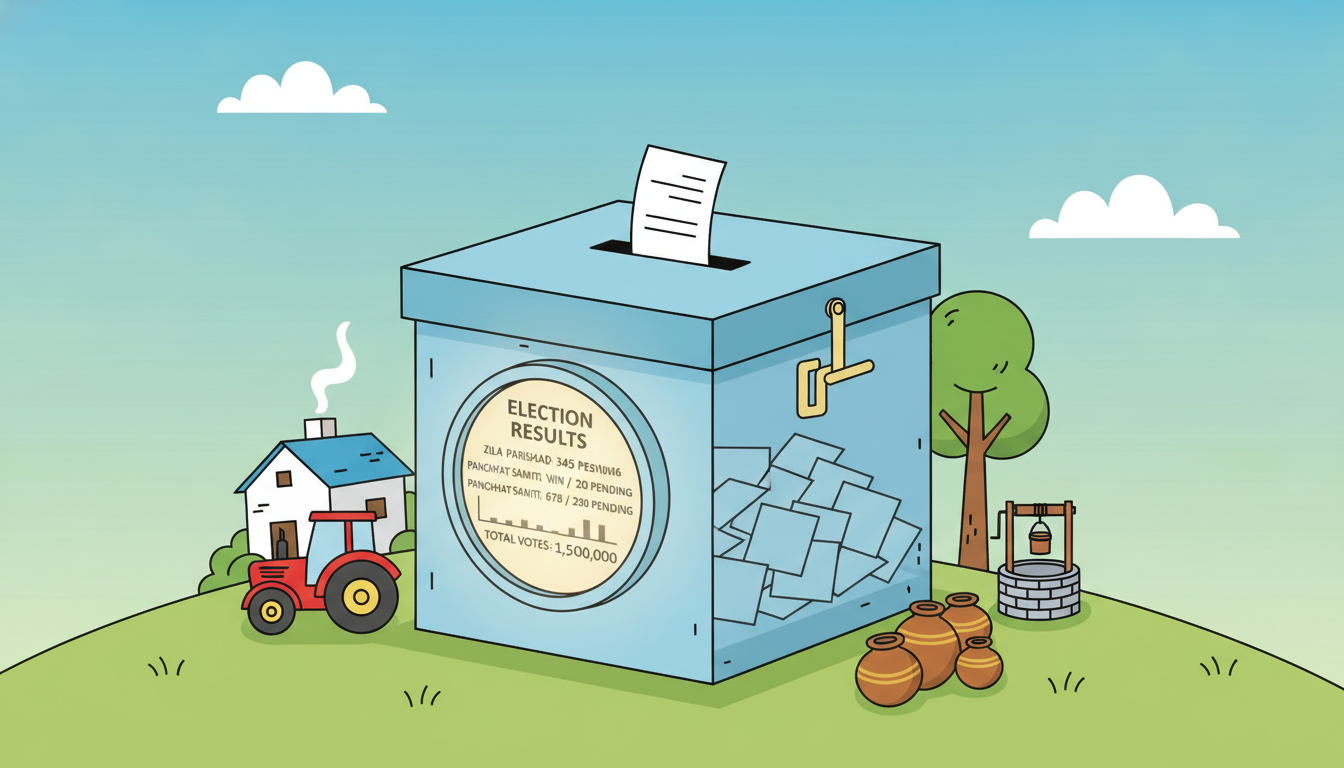
The counting of votes for the Rajasthan Panchayat Election 2026 is currently taking place today, November 20, 2026, for the Zila Parishad and Panchayat Samiti members across 37 districts. This crucial process began at 8 AM at various district headquarters, with postal ballots being counted before votes from Electronic Voting Machines (EVMs).
These elections are a vital part of India's three-tier Panchayati Raj system, which ensures local self-governance in rural areas. The Zila Parishads operate at the district level, while Panchayat Samitis work at the block level. Together, they oversee development projects, welfare schemes, and local administration.
The polling for these elections was conducted in four phases throughout October and November 2026. Specifically, Zila Parishad and Panchayat Samiti members were elected through EVMs, while Sarpanch and Ward Panch elections used traditional paper ballot boxes.
While the counting for Zila Parishad and Panchayat Samiti members is ongoing today, the results for Sarpanch and Ward Panch positions were declared immediately after polling concluded on their respective voting days in October and November.
To check the results, citizens can visit the official website of the Rajasthan State Election Commission at sec.rajasthan.gov.in. On the website, look for the 'Panchayat Election Results 2026' section. You will need to select your district and then choose the specific election category you are interested in, such as Zila Parishad, Panchayat Samiti, Sarpanch, or Ward Panch.
For detailed Sarpanch and Ward Panch results, the Gram Panchayat Details portal on the State Election Commission's website allows users to select their district, Panchayat Samiti, and Gram Panchayat to view the declared winners.
A total of 1,403 Zila Parishad seats and 8,245 Panchayat Samiti seats are being decided in these elections. More than 2.73 crore votes were cast across 45,385 polling stations.
Following the declaration of results for members, indirect elections will be held to choose the heads of these bodies. The Zila Pramukhs will be elected on November 25, Up-Zila Pramukhs on November 26, Panchayat Samiti Pradhans on November 27, and Up-Pradhans on November 28.
It's important to note that counting for four districts—Kota, Baran, Sri Ganganagar, and Karauli—will take place separately on December 17, 2026.
Earlier this year, a significant change was introduced: an amendment in 2026 removed a previous restriction that disqualified candidates with more than two children from contesting Panchayat elections, aiming for more inclusive participation.
Knowledge Vault
Panchayati Raj System
The Panchayati Raj System is a form of local self-governance in rural India. It is a three-tier structure established under the 73rd Constitutional Amendment Act of 1992, aiming to bring democracy to the grassroots level. The three tiers are the Gram Panchayat at the village level, the Panchayat Samiti at the block level, and the Zila Parishad at the district level. These bodies are responsible for local administration, development, and welfare schemes.
State Election Commission (SEC)
A State Election Commission (SEC) is an independent constitutional body in India, established under Article 243K of the Constitution. Its main responsibility is to conduct, supervise, direct, and control elections to Panchayati Raj institutions (rural local bodies) and Urban Local Bodies (municipalities) in a free, fair, and unbiased manner within its respective state. The SEC announces election schedules, issues guidelines, monitors expenditure, and declares results.
Electronic Voting Machine (EVM)
An Electronic Voting Machine (EVM) is an electronic device used to record votes in elections. It replaces traditional paper ballots and ballot boxes, aiming to make the voting process faster, more accurate, and more secure. Voters press a button next to their chosen candidate's name, and the machine records the vote digitally.
Quick check
Three questions
Check your understanding with three questions about this story.
Practice for fun. Ask a parent to create a free family account to save your scores and badges.
Which official body is responsible for conducting the Panchayat elections in Rajasthan?
- Election Commission of India
- Rajasthan State Election Commission
- Ministry of Rural Development
- District Collector's Office
How can citizens check the Rajasthan Panchayat Election Results 2026 online?
- By visiting the official website of the Rajasthan State Election Commission
- By checking social media pages of political parties
- By calling their local Gram Panchayat office
- By watching news channels only
What is the main difference in how Sarpanch/Ward Panch votes and Zila Parishad/Panchayat Samiti votes are counted?
- Sarpanch/Ward Panch votes are counted immediately after polling, while Zila Parishad/Panchayat Samiti votes are counted on a separate, later date.
- Sarpanch/Ward Panch votes are counted at district headquarters, while Zila Parishad/Panchayat Samiti votes are counted at Gram Panchayat headquarters.
- Sarpanch/Ward Panch votes use EVMs, while Zila Parishad/Panchayat Samiti votes use paper ballots.
- There is no difference; all votes are counted simultaneously at the same location.
Choose your answers and check your score in the interactive quiz when it finishes loading.