
Early Polar Vortex Split and Strong El Niño Point to Unpredictable Winter
An unusually early split in the polar vortex, combined with a very strong El Niño, suggests an unpredictable winter for parts of the Northern Hemisphere. While El Niño often brings milder conditions, the polar vortex disruption could lead to colder temperatures in some regions, making forecasts difficult.
By The Junior Post
Published
Recommended for ages 10+. Editorial guidance, not a guarantee of individual suitability.
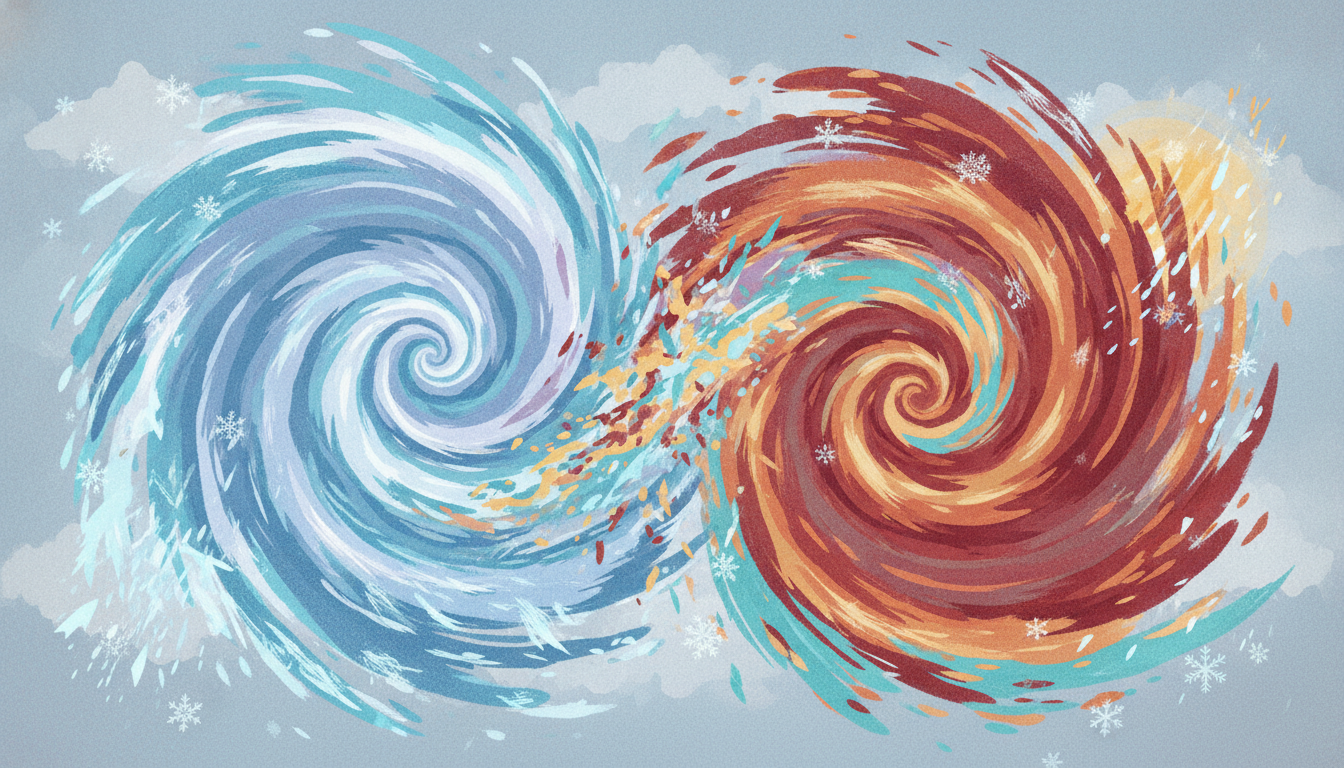
The stratospheric polar vortex, a system of strong winds high above the North Pole, split on November 10, 2026. This event happened two weeks earlier than any previous record. A split in the polar vortex can sometimes lead to very cold air moving into areas that usually experience milder winters.
At the same time, the world is experiencing an exceptionally strong El Niño. El Niño is a natural climate pattern where the waters in the tropical Pacific Ocean become warmer than average. This current El Niño is particularly strong, with Pacific Ocean temperatures reaching 3.5°C above average, which is much higher than the typical 0.5°C above average seen in other El Niño years.
Normally, El Niño years are associated with warmer-than-average temperatures in the northern United States and wetter conditions in the southern United States, from California to Florida and along the Eastern Seaboard. For Canada, El Niño typically means milder winters.
However, the early polar vortex split could bring very cold air in December, potentially clashing with the milder conditions usually expected during an El Niño. Met Office meteorologist Aidan McGivern explained that El Niño can affect atmospheric waves, which can then disturb the polar vortex, causing it to move or split. This combination of a record-breaking El Niño and an early polar vortex disruption makes forecasting the winter weather very challenging and unpredictable for regions like Canada and potentially the UK.
Knowledge Vault
Polar Vortex
The polar vortex is a large area of low pressure and cold air surrounding both of Earth's poles. It always exists, but it usually stays strong and keeps very cold air trapped near the poles. When the polar vortex weakens or splits, it can allow very cold air to move south into other regions, causing colder weather.
El Niño
El Niño is a natural climate pattern that involves the warming of ocean surface temperatures in the central and eastern tropical Pacific Ocean. This warming can affect weather patterns around the world, leading to different conditions like more rain in some areas and drier conditions in others, or warmer or colder temperatures than usual.
Atmospheric Waves
Atmospheric waves are disturbances that move through the Earth's atmosphere, similar to how ripples move on water. These waves can carry energy and influence weather patterns. When El Niño enhances these waves in the lower atmosphere (troposphere), they can travel upwards and affect higher atmospheric systems like the polar vortex.
Quick check
Three questions
Check your understanding with three questions about this story.
Practice for fun. Ask a parent to create a free family account to save your scores and badges.
What is one typical effect of an El Niño year on winter weather in the northern United States?
- Colder-than-average temperatures
- Warmer-than-average temperatures
- Heavier snowfall
- Drier conditions
What makes forecasting the upcoming winter weather difficult, according to the article?
- Only the strength of the El Niño
- Only the early polar vortex split
- The combination of a strong El Niño and an early polar vortex split
- The lack of any weather patterns
How does El Niño potentially influence the polar vortex?
- El Niño directly cools the polar vortex.
- El Niño causes the polar vortex to disappear.
- El Niño enhances atmospheric waves in the troposphere, which can disturb the polar vortex.
- El Niño has no known connection to the polar vortex.
Choose your answers and check your score in the interactive quiz when it finishes loading.