
Earth Gains a Temporary 'Mini-Moon': Asteroid 2026 QQ8
Earth has a new, albeit temporary, celestial companion: a small asteroid named 2026 QQ8. This space rock, estimated to be about 1 to 2 meters across, was pulled into a temporary orbit around our planet by Earth's gravity. It was first spotted in August 2026 by Hungarian astronomer Krisztián Sárneczky and confirmed as a natural object by the International Astronomical Union's Minor Planet Center in late October 2026.
By The Junior Post
Published
Recommended for ages 10+. Editorial guidance, not a guarantee of individual suitability.
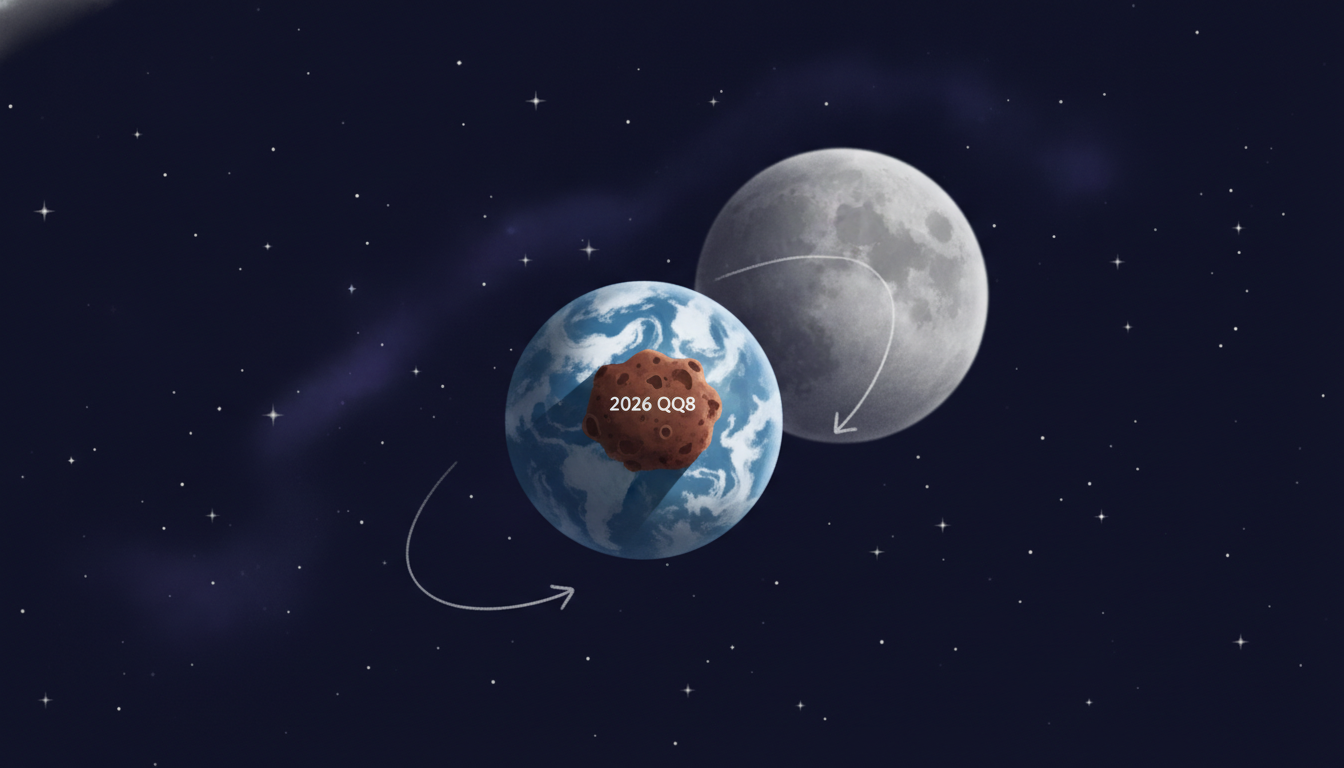
Earth has recently welcomed a new, tiny visitor to its gravitational embrace: a small asteroid officially named 2026 QQ8. This space rock, which is estimated to be only about 1 to 2 meters (around 3 to 6 feet) wide, has been temporarily captured by our planet's gravity, making it a 'mini-moon'.
The discovery of 2026 QQ8 was first made on August 20, 2026, by Hungarian astronomer Krisztián Sárneczky. Initially, there was some uncertainty about whether the object was a natural space rock or a piece of human-made space junk. However, after further observations, the International Astronomical Union's (IAU) Minor Planet Center confirmed in late October 2026 that 2026 QQ8 is indeed a natural object.
Astronomers believe that Earth's gravity pulled 2026 QQ8 into its temporary orbit around April 2026. While it's currently circling our planet, this mini-moon won't be staying for long. Scientists predict it will likely escape Earth's gravitational influence by December 2026 or early January 2027, continuing its journey around the Sun.
During its brief stay, 2026 QQ8 will not pose any danger to Earth. Its closest approach to our planet was on August 18, 2026, when it was about 537,000 kilometers (334,000 miles) away, which is about 1.5 times the distance between Earth and our permanent Moon. Because of its small size and faintness, 2026 QQ8 cannot be seen with the naked eye and requires specialized astronomical equipment for observation.
Mini-moons are not uncommon; Earth can have one at any given time. These objects are small asteroids or comets that get close enough to a planet to be temporarily captured by its gravity, make one or more loops, and then are released back into the wider solar system. Astronomers have traced 2026 QQ8's past and found it comes close to Earth approximately every 10 years, though it hasn't been captured as a mini-moon in previous close encounters like in 1965. It is also expected to come close again in 2058, but not close enough to be recaptured.
Knowledge Vault
Mini-Moon
A mini-moon is a small asteroid or comet that is temporarily captured by a planet's gravity, orbiting it for a short period before escaping back into a wider solar orbit. Unlike a planet's main moon, a mini-moon's orbit is unstable and short-lived.
Gravitational Force
Gravitational force is the invisible pull that objects with mass exert on each other. The more mass an object has, the stronger its gravitational pull. This force is what keeps planets orbiting the Sun and moons orbiting planets.
Asteroid
Asteroids are small, rocky objects that orbit the Sun. They are much smaller than planets and are often found in the asteroid belt between Mars and Jupiter, but some, like 2026 QQ8, can have orbits that bring them close to Earth.
Quick check
Three questions
Check your understanding with three questions about this story.
Practice for fun. Ask a parent to create a free family account to save your scores and badges.
What is 2026 QQ8?
- A new permanent moon of Earth
- A piece of space junk orbiting Earth
- A temporary mini-moon captured by Earth's gravity
- A newly discovered planet in our solar system
Who first discovered 2026 QQ8?
- The International Astronomical Union
- Krisztián Sárneczky
- NASA's ATLAS project
- The Lowell Discovery Telescope team
Why is 2026 QQ8 considered a 'temporary' mini-moon?
- It will collide with Earth soon.
- It will be launched back into space by a rocket.
- It will eventually escape Earth's gravity and continue its orbit around the Sun.
- It is actually a very distant star, not orbiting Earth.
Choose your answers and check your score in the interactive quiz when it finishes loading.