
India and Japan's Moon Rover Prototype Unveiled for Water Search
Japan's space agency, JAXA, has revealed a prototype rover for the Chandrayaan-5/LUPEX mission, a joint project with India's ISRO. This mission, set for launch in 2028, aims to explore the Moon's South Pole for water, which could be used as rocket fuel for future space travel. The rover will drill for samples, helping scientists understand if lunar water can make space exploration more sustainable.
By The Junior Post
Published
Recommended for ages 10+. Editorial guidance, not a guarantee of individual suitability.
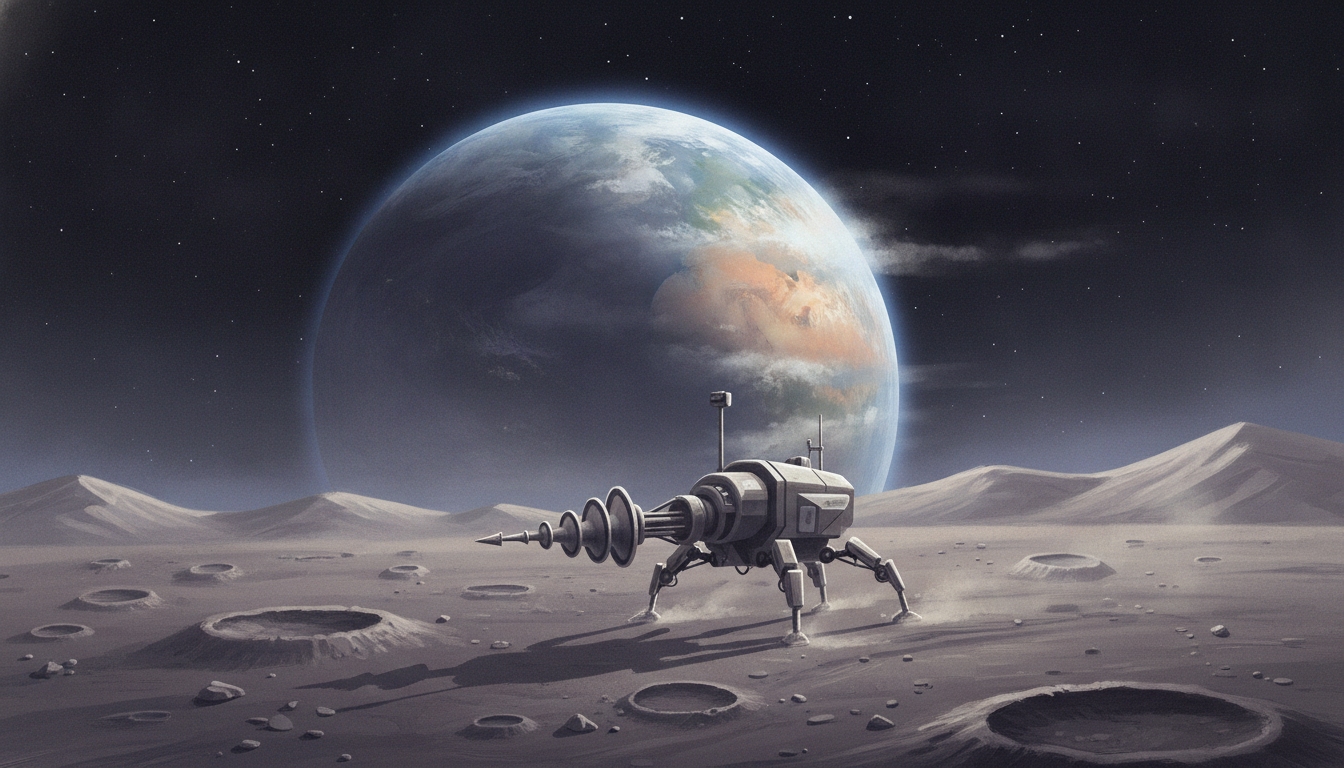
The Japanese Space Agency (JAXA) recently showed off a test model of a special rover designed to explore the Moon. This rover is part of an exciting mission called Chandrayaan-5/LUPEX, which is a team effort between JAXA and India's own space agency, ISRO.
The main goal of the Chandrayaan-5/LUPEX mission is to search for water and other important materials in the Moon's South Pole. This area has permanently shadowed regions, meaning sunlight never reaches them, and scientists believe there's a good chance of finding frozen water there. Finding water on the Moon is a big deal because it could be used to make rocket fuel, making it easier and cheaper to send missions deeper into space, perhaps even to Mars!
JAXA unveiled the prototype rover on November 25 at its Chofu Aerospace Centre in Japan, even conducting a test demonstration. The mission is planned to launch in 2028 using Japan's H3-24L rocket. While JAXA is building the rover, ISRO is in charge of developing the lunar lander, which will carry the rover to the Moon, and will also contribute some scientific instruments.
Other space agencies are also helping out. NASA is providing a Neutron Spectrometer to look for water beneath the Moon's surface, and the European Space Agency (ESA) is contributing an Exploration Mass Spectrometer to study the Moon's very thin atmosphere, called the exosphere.
The rover prototype is a four-legged model that has been tested in various ways, including climbing slopes and moving in vacuum conditions. Once it lands on the Moon, it's expected to drill into the surface to collect samples. This mission is an important step for ISRO, as it's seen as a preparation for future missions to bring Moon samples back to Earth and even to send the first Indian astronaut to the Moon by 2040.
The Chandrayaan-5/LUPEX mission is India's fifth lunar mission. Previous missions include Chandrayaan-1 in 2008, Chandrayaan-2 in 2019, and Chandrayaan-3 in 2023, which successfully landed near the lunar South Pole. Chandrayaan-4 is also planned as India's first lunar sample return mission.
Knowledge Vault
International Space Collaboration
International space collaboration happens when different countries and their space agencies work together on missions. This allows them to share knowledge, resources, and costs, making complex projects like lunar exploration possible. For example, the Chandrayaan-5/LUPEX mission is a joint effort between India's ISRO and Japan's JAXA, with contributions from other agencies like NASA and ESA.
Quick check
Three questions
Check your understanding with three questions about this story.
Practice for fun. Ask a parent to create a free family account to save your scores and badges.
What is the main goal of the Chandrayaan-5/LUPEX mission?
- To search for water and other materials at the Moon's South Pole.
- To build a permanent human base on the Moon.
- To launch a new satellite for Earth observation.
- To study the Sun's surface.
Which two space agencies are jointly collaborating on the Chandrayaan-5/LUPEX mission?
- NASA and ESA
- ISRO and JAXA
- ISRO and NASA
- JAXA and ESA
Why is finding water on the Moon important for future space exploration?
- It can be used to grow plants on the Moon.
- It could be used to make rocket fuel, making space travel more sustainable.
- It will help scientists understand ancient lunar oceans.
- It is needed for cleaning the rover's equipment.
Choose your answers and check your score in the interactive quiz when it finishes loading.