
James Webb Telescope's 'Little Red Dots' May Be Overfeeding Black Holes in the Early Universe
The powerful James Webb Space Telescope has spotted mysterious 'Little Red Dots' in the early universe. New research suggests these glowing objects could be supermassive black holes that are growing incredibly fast by 'overfeeding' on gas, helping scientists understand how these giant black holes formed so quickly after the Big Bang.
By The Junior Post
Published
Recommended for ages 10+. Editorial guidance, not a guarantee of individual suitability.
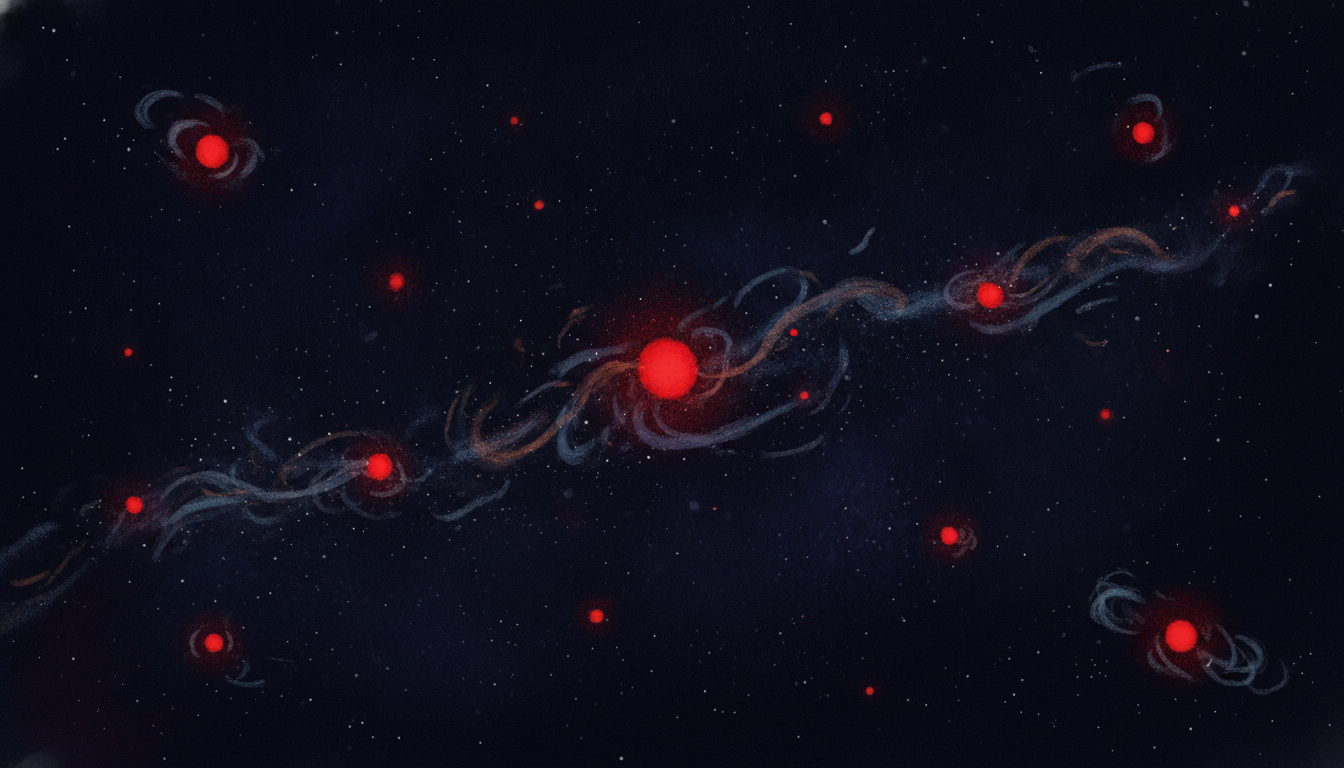
The James Webb Space Telescope (JWST) continues to amaze scientists with its incredible ability to peer deep into the universe's past. Among its many discoveries are mysterious objects nicknamed 'Little Red Dots', which have puzzled astronomers since they were first observed. These glowing spots appear in the universe's early history, roughly 600 million to 1 billion years after the Big Bang, but then seem to vanish later on.
New research suggests that these 'Little Red Dots' might actually be supermassive black holes that are growing at an astonishing rate. Imagine a black hole eating so much, so fast, that it gets completely wrapped in its own food! This 'overfeeding' creates a dense cloud of gas around the black hole, which changes the light we see, making the object appear very red.
A team led by Sunmyon Chon from the Max Planck Institute for Astrophysics in Germany used computer simulations to study the conditions in the early universe. They found that massive black holes could form and grow extremely quickly in these conditions. As they grew, they became surrounded by thick gas, which naturally created objects that looked just like the 'Little Red Dots' observed by the JWST.
This idea helps explain a big mystery: how supermassive black holes became so huge so early in the universe's life. Normally, black holes grow by slowly pulling in gas or by merging with other black holes. But in the early universe, there was an enormous supply of dense gas flowing into the centers of young galaxies, providing the perfect environment for black holes to 'overfeed' and grow rapidly.
While the simulations offer a fascinating explanation for what 'Little Red Dots' might be and how early black holes grew, they don't yet explain why these objects seem to disappear from the universe after about 1.5 billion years. Scientists are still working to solve this part of the cosmic puzzle, hoping that future observations from the JWST and more advanced simulations will provide answers.
Knowledge Vault
The Early Universe and Black Hole Growth
The early universe was a very different place than it is today, with vast amounts of gas available. This environment allowed some black holes to grow incredibly quickly, much faster than they do now. Scientists use powerful telescopes like the James Webb Space Telescope and computer models to study these ancient objects and understand how they became so massive, influencing the development of galaxies.
Quick check
Three questions
Check your understanding with three questions about this story.
Practice for fun. Ask a parent to create a free family account to save your scores and badges.
What is the main idea of the new research about 'Little Red Dots'?
- They are newly forming stars that shine very brightly.
- They are supermassive black holes that are rapidly 'overfeeding' on gas.
- They are distant galaxies colliding with each other.
- They are planets with very red atmospheres.
According to the article, approximately how long after the Big Bang were 'Little Red Dots' observed?
- Just 450 million years
- Between 600 million and 1 billion years
- About 2 billion years
- Around 11 billion years
What puzzle does the 'overfeeding black hole' theory help to solve?
- Why the universe is expanding so quickly.
- How supermassive black holes grew so large, so fast, in the early universe.
- The reason why some planets are lemon-shaped.
- How stars are formed in modern galaxies.
Choose your answers and check your score in the interactive quiz when it finishes loading.