
Japan's Data Centre Boom Sparks Concerns for City Residents
Japan is seeing many new data centres built, especially near Tokyo, to support technology like AI. However, residents living close to these large buildings are worried about noise, fumes from generators, blocked views, and safety. They are asking for stricter rules and some have even gone to court to protect their homes and communities.
By The Junior Post
Published
Recommended for ages 10+. Editorial guidance, not a guarantee of individual suitability.
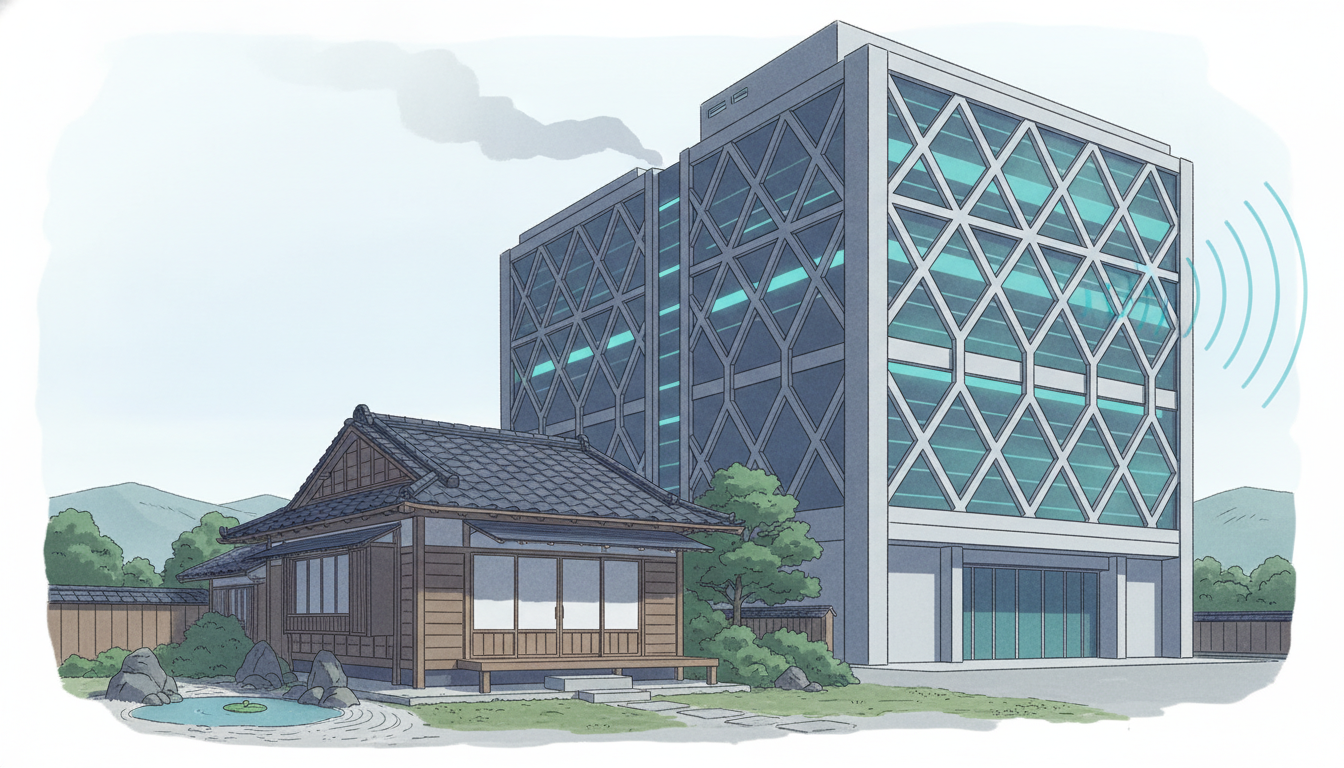
Japan is experiencing a rapid increase in the construction of data centres, which are large facilities that house computer servers to store and process vast amounts of digital information. Many of these new centres are being built in and around the Tokyo metropolitan area, a region home to about 37 million people.
While the Japanese government hopes these data centres will help the economy grow, their close proximity to homes is causing concern among residents. People living near these sites are reporting issues like loud noises, unpleasant smells, and even their views being blocked by the tall buildings.
In Kashiwa, northeast of Tokyo, Susumu Goto, a retired auto mechanic, now has two 31-metre-tall data centres owned by PAG right outside his home. He says that monthly tests of backup generators release black fumes and a burning fuel smell into the air. The noise from these tests, which can sound like a jet engine, forces him to close his windows or leave his house. He also mentioned that exhaust settles on his laundry.
Another resident, Ayano Sasaki, a 37-year-old nurse in Tokyo's Koto ward, is worried about a 51-metre data centre being built by Empyrion Digital, expected to finish in 2029. Her apartment is only 3.7 metres from the construction site. She is concerned because the plans include burying 1.2 million litres of heavy oil underground in an area known for floods and high earthquake risk. Residents in Koto have asked Tokyo for strong rules about noise, heat, and fuel safety.
In Inzai city, between Tokyo and Narita airport, residents like Junichi Takeda and the Tanikawa family are taking legal action. They are suing the city and Japan ERI, a building inspection company, over a 32-megawatt facility being built by Colt Data Centre Services. They argue that the project was wrongly approved as an 'office' instead of a 'factory' or 'warehouse,' which would have prevented its construction in a residential area. The Tanikawas were surprised when a 52-meter data center was planned next to their condo, which would be taller than their 15-story building.
Companies involved, like PAG, state they consider local environmental and community impact, and work with leaders to address concerns, including putting up sound barriers and reducing generator testing hours. USI Engineering, representing Empyrion, said their site was chosen after checking regulations and environmental impact. However, Inzai city and Japan ERI have not commented on the ongoing lawsuits.
Experts from consultancy JLL predict that Japan's data centre market will grow significantly, from $23.4 billion in 2024 to $33.4 billion by 2030. This growth is partly due to Japan's less strict regulations and stable political environment compared to some other countries. The Japanese government is working on an action plan to prevent disputes, and industry groups have also created best-practice guidelines this year as data centres continue to be built closer to homes.
Knowledge Vault
Impact of Urban Development
Urban development involves building new structures and infrastructure in cities. While this can bring economic benefits and new technologies, it can also lead to challenges for residents, such as changes to their environment, increased noise, and safety concerns. This often creates a need for careful planning and rules to balance growth with the well-being of the people living in those areas.
Quick check
Three questions
Check your understanding with three questions about this story.
Practice for fun. Ask a parent to create a free family account to save your scores and badges.
What is one main reason residents are concerned about data centres being built near their homes?
- They are worried about the loud noise and fumes from backup generators.
- They believe data centres use too much electricity.
- They think data centres make their internet slower.
- They are concerned about the lack of parking spaces.
What is the main legal argument used by residents in Inzai city against the data centre project?
- The data centre is too far from public transport.
- The project was wrongly classified as an 'office' instead of a 'factory' or 'warehouse'.
- The data centre will not create enough jobs for the community.
- The building materials used are not environmentally friendly.
Which of these is NOT a reason why Japan has become a popular location for data centre investment?
- Loose regulations for construction.
- Political stability in the country.
- High earthquake risk zones.
- Government's desire for economic growth.
Choose your answers and check your score in the interactive quiz when it finishes loading.