
Pterodactyls: Ancient Flying Reptiles That Ruled the Skies
Pterodactyls were fascinating flying reptiles that lived alongside dinosaurs millions of years ago, though they were not dinosaurs themselves. These ancient creatures, whose name means 'winged finger,' were the first vertebrates to achieve powered flight. They varied greatly in size, from as small as a bird to having wingspans wider than a small airplane, and hunted a variety of prey using their sharp beaks and teeth.
By The Junior Post
Explainer · First published
Recommended for ages 10+. Editorial guidance, not a guarantee of individual suitability.
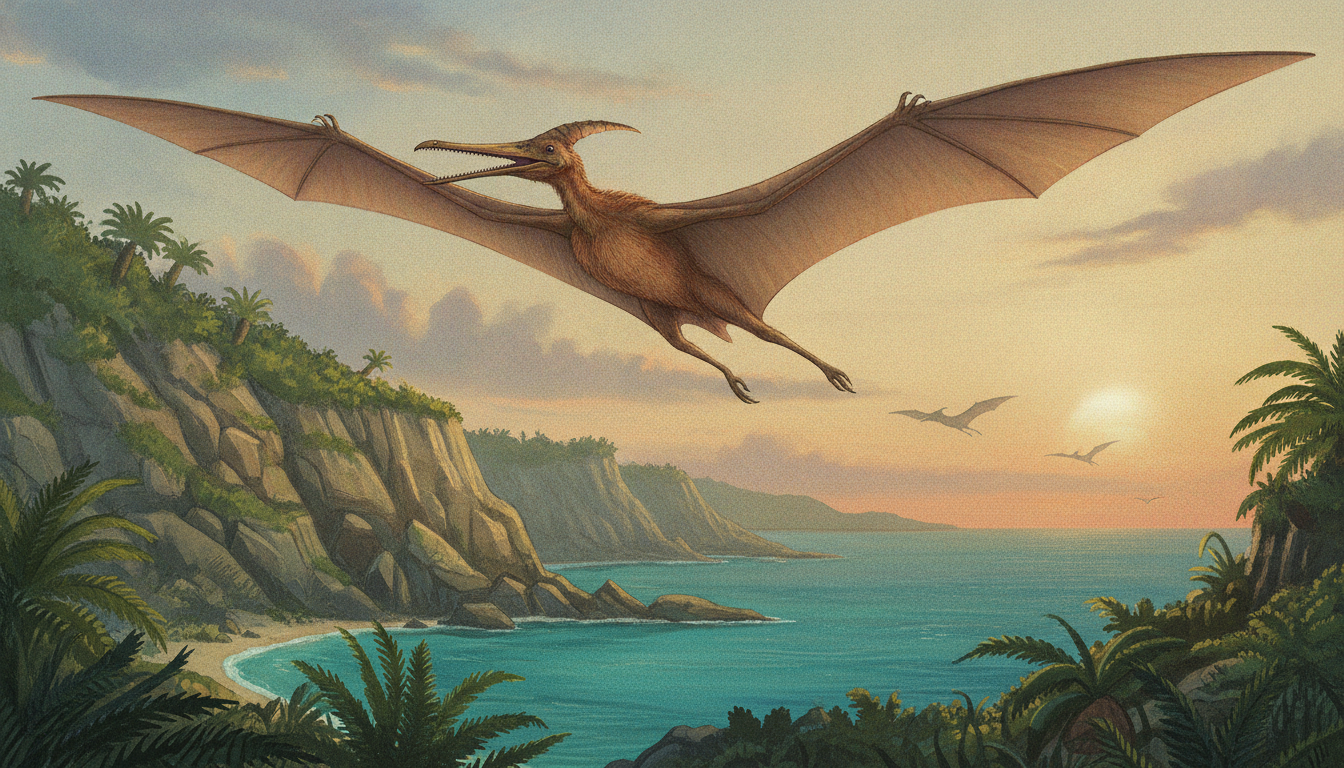
Pterodactyls were amazing flying reptiles that soared through the skies millions of years ago, during the Jurassic period. While they lived at the same time as dinosaurs, it's important to remember that pterodactyls were not actually dinosaurs themselves; they belonged to a separate group of flying reptiles called pterosaurs. The name 'Pterodactyl' comes from Greek words meaning 'winged finger,' which describes their unique wing structure.
These ancient flyers had wings made of a tough membrane of skin and muscle that stretched from their elongated fourth finger to their hind limbs, much like a bat's wing. This special design allowed them to be the first vertebrates to achieve powered flight. Pterodactyls had lightweight, hollow bones, which helped them stay light enough to fly.
The most well-known species, *Pterodactylus antiquus*, was relatively small, with an adult wingspan of about 1.04 meters (around 3 feet 5 inches), similar to the size of a large bird. However, other pterosaurs, often informally called 'pterodactyls,' varied greatly in size, with some having wingspans as small as 25 centimeters and others reaching up to 11 meters, which is wider than a small airplane.
Pterodactyls were carnivores, meaning they ate meat. Their diet included fish, insects, and small animals. They used their sharp beaks and small, pointed teeth to catch their prey, often swooping down over water to snatch fish.
Fossils of *Pterodactylus* have been found mainly in the Solnhofen limestone of Bavaria, Germany, dating back about 150.8 to 148.5 million years ago. The first *Pterodactylus* fossil was described in 1784 by Italian scientist Cosimo Alessandro Collini, though he initially thought it was an aquatic animal. It was later recognized as a flying reptile by French naturalist Georges Cuvier.
Pterodactyls lived in warm coastal regions, near shallow seas, lagoons, rocky cliffs, and islands, which provided ideal hunting grounds. They had large eyes, helping them spot prey from high in the sky. While they could fly at fast speeds, they likely spent much of their time gliding on air currents. When on the ground, some pterodactyls were bipedal, meaning they walked on two hind legs.
It's important to distinguish *Pterodactylus* from *Pteranodon*, another famous pterosaur. *Pteranodon* lived later, during the Late Cretaceous period, was much larger, and did not have teeth, unlike *Pterodactylus* which had many small teeth. *Pteranodon* also had a prominent bony crest on its head, while *Pterodactylus* had a smaller crest made mostly of soft tissues. Both, however, were incredible examples of prehistoric flight.
Knowledge Vault
Pterosaurs vs. Dinosaurs
Pterosaurs were flying reptiles that lived during the same time as dinosaurs, but they were not dinosaurs. Dinosaurs were primarily land-dwelling reptiles, while pterosaurs were adapted for flight. Both groups are part of a larger reptile group called archosaurs.
Adaptations for Flight
Pterodactyls had several special features that helped them fly. These included lightweight, hollow bones to reduce their body weight, and wings made of a strong membrane of skin and muscle. Their elongated fourth finger supported these wings, allowing them to glide and soar through the air.
Fossil Discovery and Interpretation
The discovery of fossils helps scientists learn about ancient life. When the first Pterodactylus fossil was found, scientists initially thought it was an aquatic animal. Over time, with more study and discoveries, they realized it was a flying reptile, showing how scientific understanding can evolve as new evidence emerges.
Quick check
Three questions
Check your understanding with three questions about this story.
Practice for fun. Ask a parent to create a free family account to save your scores and badges.
Which of these is a key difference between Pterodactyls and Pteranodons mentioned in the article?
- Pterodactyls were dinosaurs, while Pteranodons were not.
- Pterodactyls had teeth, while Pteranodons did not.
- Pterodactyls lived in the Late Cretaceous, while Pteranodons lived in the Late Jurassic.
- Pterodactyls had feathers, while Pteranodons had skin wings.
What was the primary material that made up a Pterodactyl's wings?
- Feathers
- Bones
- Skin and muscle membrane
- Woody fibers
Where have most of the fossils of the *Pterodactylus* genus been found?
- North America
- Africa
- Bavaria, Germany
- China
Choose your answers and check your score in the interactive quiz when it finishes loading.