
SpaceX Starship Completes Historic Orbital Flight and Landing
SpaceX's Starship spacecraft successfully completed its 15th test flight, reaching Earth orbit, deploying satellites, and performing an unprecedented upright landing at its launch tower in South Texas. This marks the first time an orbital rocket's upper stage has returned for a safe, upright landing, a major step towards fully reusable rockets.
By The Junior Post
Published
Recommended for ages 10+. Editorial guidance, not a guarantee of individual suitability.
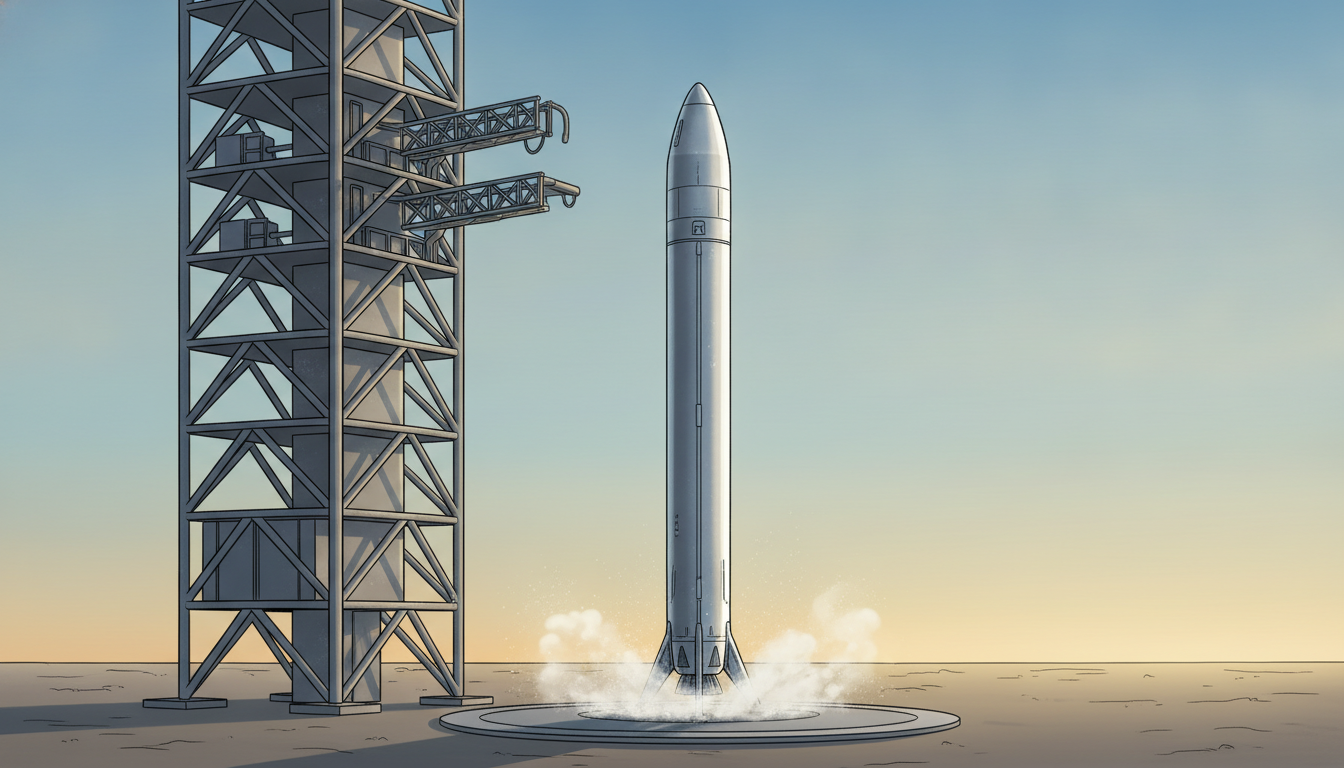
On Saturday, November 14, 2026, SpaceX achieved a significant milestone in space exploration. Its Starship spacecraft, which is the upper part of the very large Starship launch system, successfully landed upright at the Mechazilla launch tower in South Texas. This was the first time in the history of rocketry that the upper stage of an orbital rocket returned from space and landed safely in this way. This achievement is important because it shows that rockets can be reused, which could make space travel more affordable.
The mission, called Flight 15, began on Friday, November 13, 2026, and lasted 22 hours. During this time, the 171-foot-tall Starship spacecraft reached Earth orbit and traveled around the planet 14 times. It also deployed 26 Starlink internet satellites, which are part of Elon Musk's plan to provide internet access from space.
While the Starship spacecraft's landing was successful, the Super Heavy booster, which is the bottom part of the launch system, did not land as planned at the launch tower. Instead, it was directed to splash down safely in the Gulf of Mexico. Despite this, SpaceX considers Flight 15 a "massive milestone" because of the successful return and landing of the Starship upper stage, bringing the idea of fully reusable rockets closer to reality.
This success is a big step for the space industry. Reusable rockets can greatly lower the cost of space missions and allow for more frequent launches. SpaceX had previously managed to catch returning booster rockets three times, but catching the Starship upper stage was more difficult because it traveled at higher speeds and from a greater altitude.
Knowledge Vault
Reusable Rockets
Reusable rockets are spacecraft designed to return to Earth after a mission and be used again for future launches. This is different from traditional rockets, which are often discarded after a single use. Reusing rockets can significantly lower the cost of space travel, making it more affordable and allowing for more frequent missions into space.
Orbital Flight
Orbital flight means a spacecraft travels fast enough to stay in space, circling around a planet or other celestial body. To achieve orbit, a rocket must reach a certain speed and altitude, allowing it to continuously fall around the Earth without hitting it. This is how satellites stay in space.
Starlink Satellites
Starlink is a satellite internet constellation operated by SpaceX. It consists of thousands of small satellites in low Earth orbit that work together to provide internet access to users on the ground, especially in remote areas where traditional internet services might be unavailable or unreliable.
Quick check
Three questions
Check your understanding with three questions about this story.
Practice for fun. Ask a parent to create a free family account to save your scores and badges.
What was the main achievement of SpaceX's Flight 15?
- The Super Heavy booster successfully landed at the launch tower.
- The Starship spacecraft deployed satellites and landed upright after an orbital flight.
- The mission was the first time any rocket reached Earth orbit.
- SpaceX launched the world's smallest rocket system.
Why is the successful landing of the Starship spacecraft considered a "massive milestone"?
- It was the longest space mission ever recorded.
- It proved that rockets can be used only once, saving money.
- It demonstrated the possibility of fully reusable rockets, which can reduce costs and allow more frequent launches.
- It was the first time satellites were deployed in space.
What happened to the Super Heavy booster during Flight 15?
- It also landed successfully at the Mechazilla launch tower.
- It was redirected to splash down in the Gulf of Mexico.
- It continued into deep space with the Starship spacecraft.
- It was caught by a special net in the air.
Choose your answers and check your score in the interactive quiz when it finishes loading.