
Voyager 1: Exploring the Universe One Light-Day at a Time
NASA's Voyager 1 spacecraft, launched in 1977, is the farthest human-made object from Earth. It has traveled so far that light and radio signals now take over 22 hours to reach it, a distance approaching one 'light-day'. The probe continues its journey through interstellar space, sending back valuable data and carrying a special message from Earth.
By The Junior Post
Published
Recommended for ages 10+. Editorial guidance, not a guarantee of individual suitability.
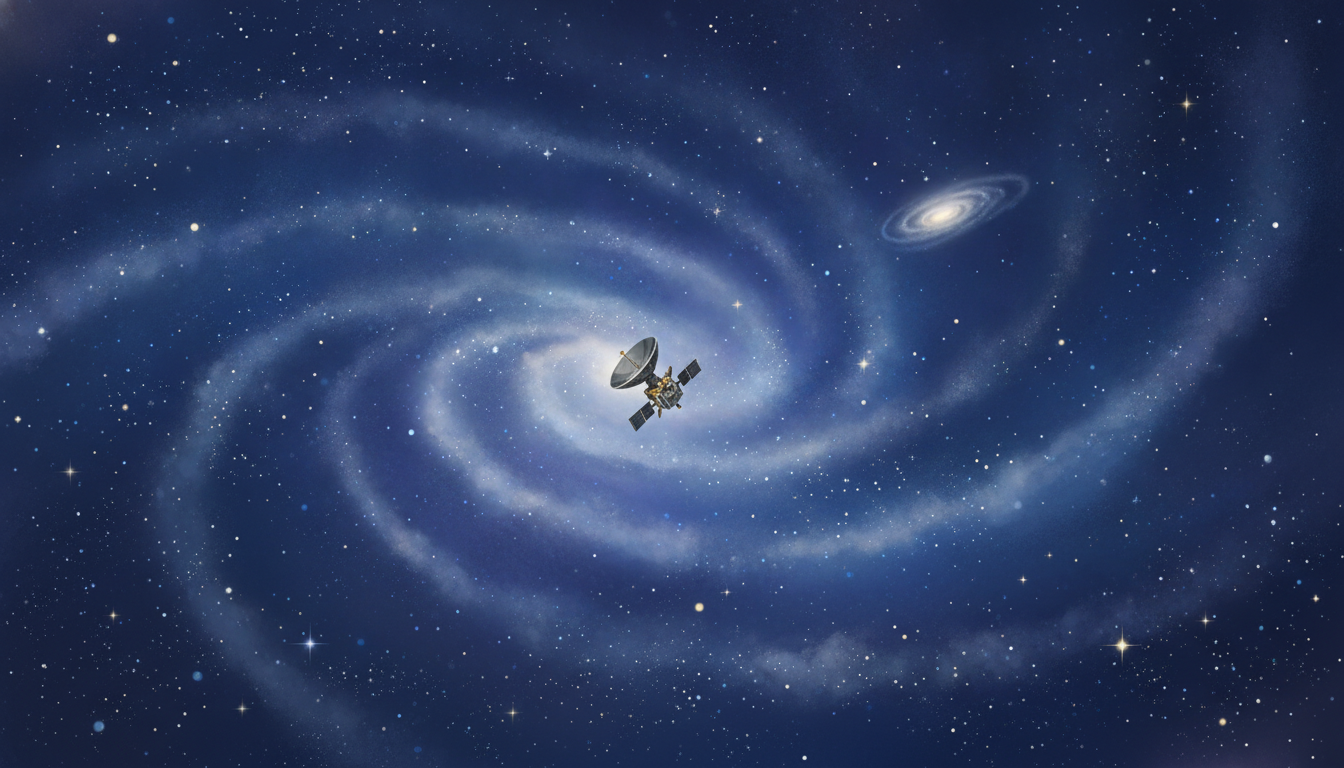
NASA's Voyager 1 spacecraft is the farthest human-made object from Earth, continuing its incredible journey into deep space. It has traveled so far that light and radio signals now take over 22 hours to reach it, meaning it is approaching the remarkable distance of one 'light-day' from our planet. This ongoing journey marks a significant chapter in humanity's exploration of the cosmos.
So, what exactly is a light-day? Imagine light traveling at an astonishing speed of about 300,000 kilometers (186,000 miles) every single second! A light-day is simply the total distance that light covers in 24 hours. That distance is enormous – roughly 25.9 billion kilometers (16.1 billion miles). To give you an idea, that's about 173 times the distance from Earth to the Sun!
Because Voyager 1 is now so far away, communicating with it is quite a challenge. If scientists on Earth send a radio signal to the spacecraft, it takes over 22 hours for that message to arrive. Then, if Voyager 1 sends a signal back, it takes another 22+ hours for us to receive it. This means any conversation with the probe has a delay of nearly two days!
Voyager 1 began its epic journey on September 5, 1977, launched by NASA to explore the outer parts of our solar system. Its mission was originally planned for just five years, but it has far exceeded all expectations, operating for over 49 years!
During its long mission, Voyager 1 has made many groundbreaking discoveries. It flew past Jupiter in March 1979 and Saturn in November 1980, sending back stunning images and helping scientists discover new moons and rings around these gas giants. In 1990, it turned its camera back towards Earth to capture the famous 'Pale Blue Dot' photograph, showing our planet as a tiny speck in the vastness of space.
A huge moment for Voyager 1 came on August 25, 2012, when it became the first human-made object to cross the heliopause and enter interstellar space – the region between stars. It continues to explore this uncharted territory, sending back data about cosmic rays and magnetic fields from beyond our Sun's influence.
Voyager 1 also carries a special message for any intelligent life it might encounter: a 'Golden Record.' This phonograph record contains sounds and images from Earth, including greetings in many languages, music, and pictures of our planet and its inhabitants. It's like a time capsule floating through space!
Even after nearly five decades, Voyager 1 is still working, though some of its instruments have been turned off to save power. While engineers are currently investigating an issue with its data transmission, the spacecraft continues to send a signal, proving its incredible durability and the human spirit of exploration.
Knowledge Vault
Light-Day as a Unit of Distance
A light-day is a unit of distance used in astronomy, not a measure of time. It represents the total distance that light travels through the vacuum of space in exactly 24 hours. Because light travels incredibly fast (about 300,000 kilometers or 186,000 miles per second), a light-day covers an enormous distance, approximately 25.9 billion kilometers (16.1 billion miles). This unit helps scientists describe the vast distances between objects in our solar system and beyond.
Quick check
Three questions
Check your understanding with three questions about this story.
Practice for fun. Ask a parent to create a free family account to save your scores and badges.
What does it mean for Voyager 1 to be approaching one 'light-day' from Earth?
- It means the spacecraft has been traveling for one day.
- It means light takes nearly one day to travel from Earth to the spacecraft.
- It means the spacecraft is traveling at the speed of light for one day.
- It means the spacecraft will reach a star in one day.
Which of these is a major achievement of the Voyager 1 mission?
- Landing on Mars.
- Becoming the first human-made object to enter interstellar space.
- Discovering new planets outside our solar system.
- Returning to Earth after its mission.
What is the purpose of the 'Golden Record' carried by Voyager 1?
- To store scientific data collected during the mission.
- To serve as a time capsule with sounds and images of Earth for potential extraterrestrial life.
- To help navigate the spacecraft through space.
- To provide power to the spacecraft's instruments.
Choose your answers and check your score in the interactive quiz when it finishes loading.