
Ancient Owl Fossil Reveals Daytime Hunting Habits 47 Million Years Ago
A remarkably preserved owl fossil, dating back 47 million years, suggests that some ancient owls may have hunted during the day. The discovery includes the owl's last meal, an iridescent cockroach, providing new clues about when owls became primarily nocturnal.
By The Junior Post
Published
Recommended for ages 10+. Editorial guidance, not a guarantee of individual suitability.
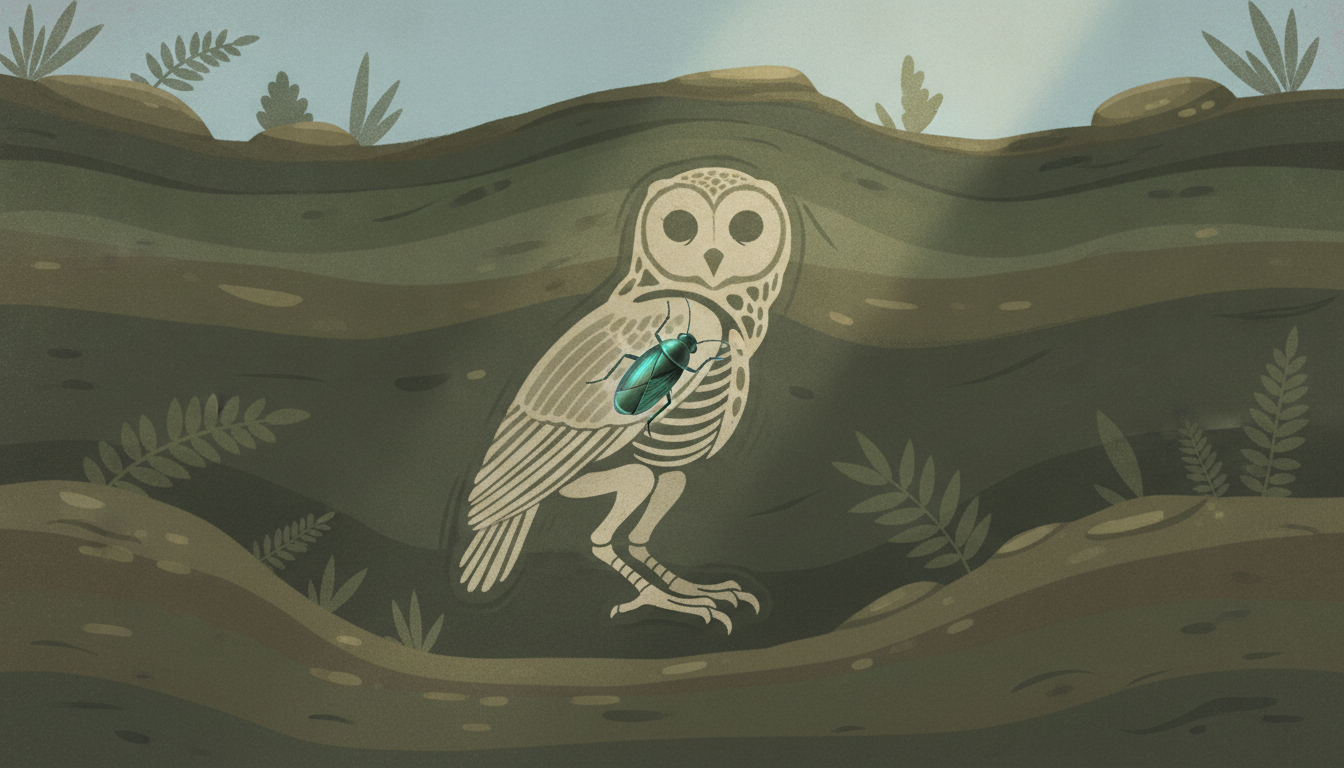
Scientists have found an incredibly well-preserved fossil of a tiny owl, estimated to be 47 million years old. This fossil is special because it includes the owl's last meal still inside its stomach: a greenish-blue, shiny cockroach.
The owl, named *Masillastrix blattophaga*, was less than 12 centimeters long. Its physical features, such as strong arm bones (humerus) and flight feathers that were not highly specialized, suggest it might have been active during the day.
Gerald Mayr, a paleontologist from the Senckenberg Research Institute, explained that the iridescent (shiny) cockroach found in the owl's stomach is usually active during daylight hours. This detail, along with the owl's bone structure, points to the idea that this ancient owl was likely diurnal, meaning it was active during the day.
This discovery gives important insights into how owls evolved. It suggests that the change for owls to become mostly nocturnal happened later in their history, specifically between 47 million and 34 million years ago. Before this, there is a general agreement among scientists that owls evolved from ancestors that were active during the day.
Knowledge Vault
Fossil Preservation
Fossil preservation is the process by which the remains or traces of ancient life are saved in rock or other materials. When an animal or plant dies, its soft parts usually decay, but hard parts like bones, teeth, or shells can be replaced by minerals over millions of years, forming a fossil. Sometimes, even very delicate things like the last meal in an animal's stomach can be preserved, giving scientists amazing clues about ancient life.
Evolutionary History
Evolutionary history refers to the study of how different species have changed and developed over very long periods of time. By looking at fossils and comparing living animals, scientists can piece together the story of how animals like owls adapted to their environments, changed their behaviors (like hunting at night or day), and developed new physical features.
Check your understanding
- What key piece of evidence found in the fossil suggests that *Masillastrix blattophaga* might have been diurnal?
- Its large size compared to modern owls.
- The type of trees found near the fossil.
- The remains of an iridescent cockroach in its stomach.
- The color of its feathers.
- According to the article, what is the general consensus among scientists about the ancestors of owls?
- They were always nocturnal.
- They evolved from a diurnal ancestor.
- They lived underwater.
- They were much larger than modern owls.
- When do researchers estimate the transition to predominantly nocturnal behavior in owls occurred?
- Within the last 10,000 years.
- Between 47 million and 35 million years ago.
- Over 100 million years ago.
- It is still unknown and not estimated.